TAUNT.BET is a pre-launch, on-chain player-versus-player (PvP) casino built on the Solana blockchain. It positions itself as a fundamentally different kind of gambling platform: one where players bet against each other rather than against the house, eliminating the traditional house edge entirely. Every wager is recorded on-chain, and the platform claims full provable fairness without relying on a centralised operator to hold a mathematical advantage over its users.
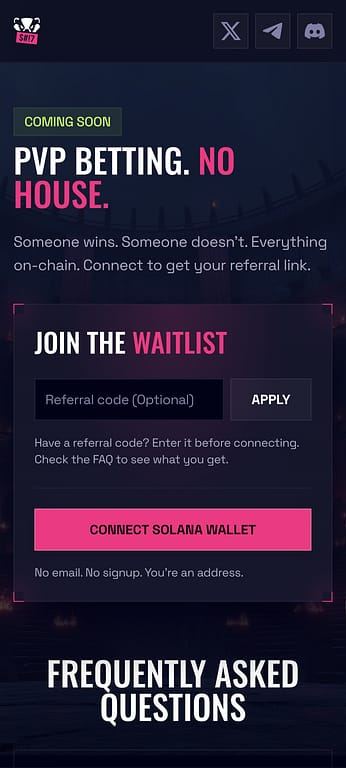
At the time of writing, TAUNT has not launched. The platform is collecting waitlist signups via a Solana wallet connection, with no email address or identity verification required. A referral system is active, a Telegram community is running pre-launch contests, and the team has begun building a public presence on X (formerly Twitter).
Official Website
https://taunt.bet/
The Model: Exchange, Not Casino
The clearest articulation of what TAUNT actually is came not from its marketing copy but from a reply posted by the team on X in response to criticism. In it, they described their approach as analogous to an exchange rather than a market maker: they take no position on the outcome of any game, they do not care who wins, and they collect a fee from the action rather than profiting from player losses.
This is a meaningful distinction. In a conventional casino, the house is always on the other side of the bet. In a PvP model, two players are matched against each other, and the platform takes a cut of the pot as a service fee. The result is that no participant is structurally disadvantaged by the design of the platform itself — only by the skill, luck, or strategy of their opponent.
This model is not without precedent. Betting exchanges such as Betfair have operated on similar principles in the sports betting world for over two decades. Poker rooms take a rake rather than competing against players directly. What TAUNT appears to be doing is applying this logic to casino-style games on a decentralised blockchain infrastructure.
On the ‘No House Edge’ Claim
TAUNT’s primary marketing claim — that there is no house edge — requires some unpacking. The team themselves acknowledged on X that their initial framing was an exaggeration, conceding that reputable casinos do display return-to-player percentages openly, and that provably fair systems, when implemented correctly, do what they claim.
What is more accurately true is that TAUNT does not take a position against its players. However, a platform fee does exist. The referral programme literature references a “platform fee” from which referrers earn between 10% and 40%. One reply on X from a user alleged this fee sits at approximately 5%, though this figure has not been independently confirmed. The team has stated fees will be transparent, which, if delivered, would satisfy reasonable due diligence requirements.
The honest summary is this: TAUNT does not profit from you losing. It profits from you playing. Whether that distinction matters to a given player will depend on their expectations and how the fee structure compares to alternatives once full details are published.
Blockchain Infrastructure & Transparency
TAUNT is built on Solana, one of the higher-throughput blockchains currently in operation. This is a sensible choice for a gambling application: Solana offers fast transaction confirmation and low fees relative to Ethereum, both of which matter when individual bets may be frequent and of modest size.
All bets are described as being recorded on-chain permanently. This is a strong transparency claim — in principle, any observer can verify the outcome of any game. Provable fairness in this context means that neither the platform nor any party can retroactively alter a result. The value of this guarantee, however, depends entirely on the implementation. The team has committed to keeping everything open for review and feedback, but no independent audit has been published at this stage.
From a user experience standpoint, interaction requires only a Solana wallet. There is no account creation, no email address, and no KYC process. Your identity on the platform is your wallet address. This is a meaningful privacy advantage for users who prefer not to submit personal documentation, though it also means the platform operates outside conventional regulatory frameworks in most jurisdictions.
Join the Waitlist
Getting on the TAUNT waitlist requires nothing more than a Solana wallet. No email, no account, no identity verification. If you have a referral code, it must be entered before connecting — this is what locks in the permanent fee rebate for referred users. After connecting, users receive a loot crate immediately and land on a personal dashboard.
From there, the dashboard presents a customisable referral link, a live referral tracker, and an invitation to join the Telegram and Discord communities, where pre-launch contests, game previews, and mechanic votes are already running.
The onboarding is lean and deliberate. It asks little, activates the referral loop immediately, and gets users into the community in one step. The substance behind it — what the loot crate contains, what the community delivers — will only be measurable at launch.
Pre-Launch Community & Communication
TAUNT’s pre-launch community activity is centred on Telegram. The platform runs weekly contests with prizes ahead of launch, offers first looks at game footage, and — notably — allows community members to vote on game mechanics before they are shipped.
On X, the team has shown a willingness to engage critically and in good faith with sceptics. When challenged on their marketing claims, they did not deflect — they acknowledged the overstatement, clarified their actual model, and engaged with the substance of the criticism.
The brand voice is aggressive and crypto-native by design. Phrases like “your degen friends” and “everything is PvP” in the platform bio signal a deliberate targeting of the on-chain gambling community. This will resonate with part of the audience and alienate another.
What We Don’t Know Yet
As a pre-launch platform, several material questions remain unanswered:
- What games will be available at launch and what are their specific mechanics?
- What is the exact platform fee, and how does it vary by game type?
- How are the referral tiers (10%–40%) calculated and assigned?
- Who is the team behind TAUNT, and what is their track record?
- Has any independent security or smart contract audit been conducted or commissioned?
- What is the legal and regulatory status of the platform, and in which jurisdictions does it operate or restrict access?
- What exactly is contained in the ‘loot crate’ provided to early joiners?
This review will be updated upon launch when game mechanics, fee structures, and on-chain performance can be evaluated directly.