- 🎲 How the Game Works
- 🌈 The Six Colours — and Why They All Have Equal Odds
- 🎯 The Three Bet Types: Rules, Payouts and the Maths Behind Them
- 📐 Understanding the House Edge and RTP
- ✨ The Multiplier System
- 🧠 Strategy — What Actually Makes a Difference
- 💰 Bankroll Management
- 🚫 Common Mistakes — and the Maths That Explains Them
- 📊 Quick Reference — All Bets at a Glance
- 🏁 Final Verdict — Is Super Color Game Worth Playing?
⚡ Quick Summary
- Evolution launched Super Color Game in May 2025, inspired by the Filipino perya carnival dice tradition
- Three real physical dice roll down a pin board — pick a colour and bet whether 1, 2, or all 3 dice land on it
- Random multipliers up to 1,000× are assigned to bet spots each round before the roll
- All three bet types carry a near-identical house edge of roughly 4.4% — there is no magic bet
- Best advice for most players: flat-stake Single bets for the longest, most enjoyable sessions
🎲 How the Game Works
Super Color Game is a live-dealer dice game developed by Evolution Gaming and released on 14 May 2025. It is directly inspired by the Filipino perya carnival game known simply as “Color Game,” a beloved street-fair staple played at town fiestas across the Philippines for generations. Evolution kept the soul of the original — six coloured faces, bet on what comes up — and added live-dealer production quality and a random multiplier mechanic on top.
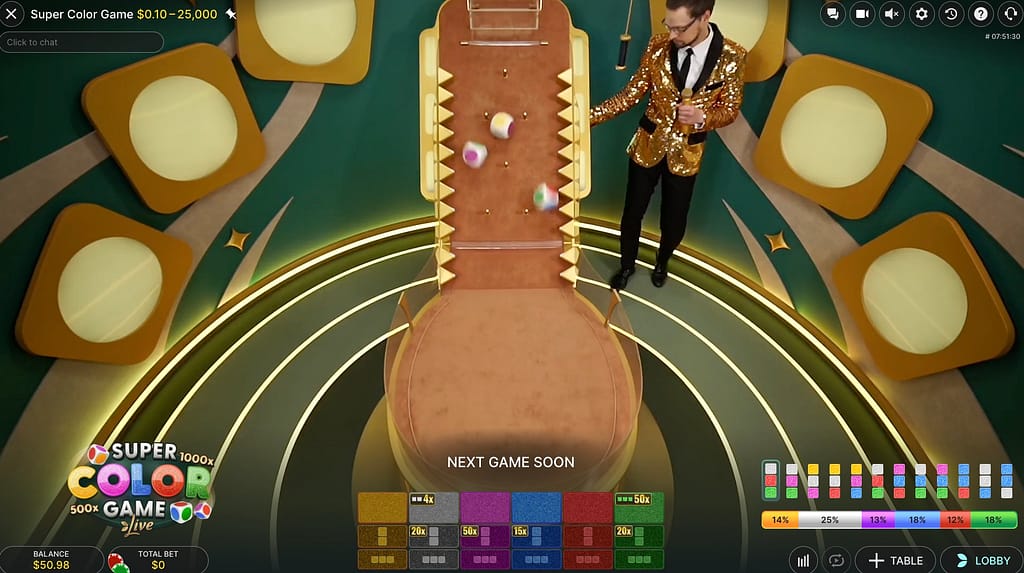
The physical setup is striking. Three oversized six-sided dice are released down a vertical, pin-studded chute — similar in structure to a Plinko board. The pins deflect the dice randomly as they tumble, and they settle face-up at the bottom. The upward-facing colour on each die determines the winning combination for that round. Critically, the dice are real physical objects, not a software RNG roll. The only computer-generated element in the round is the random multiplier assignment, which happens before the roll.
Here is what happens during each round, step by step:
Step 1 — Bet
Betting window opens. You have roughly 15–18 seconds to place chips on any of the 18 positions.
Step 2 — Multipliers
Betting closes. The system randomly assigns multipliers to some bet spots (up to 18 in total).
Step 3 — Roll
The host releases three physical dice down the pin board. They tumble and settle.
Step 4 — Payout
Winning bets are paid at base odds — or the multiplier amount if one was assigned.
Before your first session it is worth deciding in advance which colour and which bet type you want to use, so you are not scrambling to click in time. Many experienced players pick one colour, keep the same bet size every round, and simply watch the board — that discipline alone will save you from impulsive overbet rounds.
🌈 The Six Colours — and Why They All Have Equal Odds
Each of the three dice has exactly six faces, one painted in each of the following colours:
🟡 Yellow
⚪ White
🩷 Pink
🔵 Blue
🔴 Red
🟢 Green
Since each die has exactly one face per colour, each colour has a 1-in-6 (16.67%) chance of appearing on any single die. This is fundamental: there is no “hot” colour, no colour with better long-run odds than any other, and no pattern to exploit. The dice have no memory of previous rolls.
The on-screen statistics panel showing colour frequencies is a common trap for new players. If Red has come up eight times in the last twenty rolls, many players feel intuitively that Red is “overdue” to be less common, or that it is “running hot” and will keep coming. Neither instinct is mathematically correct — and both lead to bigger, poorly reasoned bets. Each roll resets completely.
🎯 The Three Bet Types: Rules, Payouts and the Maths Behind Them
For each of the six colours there are three betting positions, giving 18 spots in total. The three bet types differ in how many dice need to show your colour for you to win. Let’s look at each one in detail — including the exact probability maths.
📐 Understanding the House Edge and RTP
Return to Player (RTP) is the percentage of every pound (or dollar, or euro) wagered that the game pays back to players over millions of rounds. An RTP of 95.54% means that for every £100 staked in total across all players, the game returns £95.54 on average, keeping £4.46 for the casino. That retained £4.46 is the house edge.
Here is a concrete illustration. Imagine you play 200 rounds at £1 per round, staking £200 in total. With an RTP of 95.54%, your expected return is £191.08 — meaning an expected loss of £8.92. In reality your actual result will be scattered widely around that expectation: some sessions you’ll be up, many you’ll be down. But the longer you play, the more the maths pulls your result toward that long-run loss.
📐 The Maths in Full — Where Does the House Edge Come From?
For a Single bet at £1, the expected value per round breaks down like this:
That −£0.0787 loss per £1 staked is a house edge of 7.87% on the base game without multipliers. The random multipliers, baked into the published RTP, reduce this to 4.46% by occasionally boosting payouts significantly. This is why the multipliers are not just a gimmick — they are mathematically essential to the game’s advertised RTP.
How does Super Color Game’s 4.4% edge compare to other live casino games? The contrast is stark:
| Game | House Edge | RTP |
|---|---|---|
| Baccarat (Banker bet) | ~1.06% | 98.94% |
| Blackjack (basic strategy) | ~0.5% | 99.5% |
| European Roulette | 2.70% | 97.30% |
| Super Color Game (Single) | 4.46% | 95.54% |
| Super Color Game (Double) | 4.39% | 95.61% |
| Super Color Game (Triple) | 4.38% | 95.62% |
The takeaway is clear: Super Color Game returns meaningfully less than the classic table games. This does not make it a bad game — it makes it a high-entertainment, lower-RTP game. You pay a higher premium for the spectacle of live dice, bright colours, and the possibility of a 1000× hit. Whether that premium is worth it is entirely a personal call.
✨ The Multiplier System
Before each roll, a random number of multipliers — up to a maximum of 18 (one per betting position) — are assigned by the game’s RNG to specific spots on the betting grid. This happens after the betting window closes, so you cannot see which spots have multipliers when placing your bets. You see the multipliers revealed on screen just before the dice roll.
How multipliers interact with payouts: A multiplier replaces the base payout, it does not multiply it. If your Double bet has a 20× multiplier assigned to it and you win, you receive 20× your stake — not 20 × 8 × your stake. The multiplier is the new payout rate. This is an important distinction that many players misread.
⚠️ Common Multiplier Misconception
Many players assume a 100× multiplier on a Double bet means they win 100 × 8 = 800× their stake. That is incorrect. The multiplier replaces the base 8:1 payout entirely. A 100× multiplier pays 100× your stake — full stop. Still excellent, but not 800×.
Similarly, if a Single bet wins with only one matching die, no multiplier can apply at all, regardless of whether a multiplier was assigned to that spot. Multipliers on Single bets only activate when two or three dice match.
The multiplier ranges per bet type are as follows:
Single — 2 dice match
4× – 10×
Single — 3 dice match
10× – 100×
Double
15× – 100×
Triple
200× – 1,000×
In practice, players typically see only a handful of multipliers per round — not all 18 positions filled. Evolution’s official language is “up to 18 random multipliers,” which confirms the maximum, not the average. Do not structure your betting around an assumption that multipliers will appear frequently on the spots you chose.
The multipliers are what make the Triple bet worth its low base payout. Without multipliers, the Triple’s 150:1 payout would face a theoretical edge of around 30% — unplayable. With the 200×–1000× multiplier range factored in across millions of rounds, the RTP lifts to 95.62%. Still a high house edge game, but not predatory in the way that pure 150:1 would be.
🧠 Strategy — What Actually Makes a Difference
Let’s be direct: because all three bet types have nearly the same house edge (the spread is just 0.08% from best to worst), there is no bet selection that beats the house. No colour, no combination, no pattern play changes the long-run maths. What strategy can do is manage variance — meaning how wild your session swings feel — and pace your bankroll so you get the most enjoyment per pound spent.
🏅 Strategy 1: The Steady Player (Best for Most People)
Approach: Flat-stake Single bets only, same colour every round, same stake every round.
Why it works: With a ~42% win rate, you’ll win roughly two out of every five rounds. This creates a slow, sustainable rhythm. Losing streaks of 5–10 rounds are common but survivable on a reasonable budget. You still catch multipliers occasionally when two or three dice match.
Real-world feel: At £0.50 per round over 100 rounds (£50 total staked), expected loss is about £2.25. You’ll have winning sessions and losing sessions, but the swings are manageable.
Best for: Anyone new to the game, budget-conscious players, or those who want to watch and enjoy without constant stress.
🎲 Strategy 2: The Balanced Approach
Approach: A main Single bet on one colour plus a smaller Double bet on the same colour. For example, £1 Single and £0.25 Double on Blue each round.
Why it works: The Single gives you frequent small wins (and therefore more “action”) while the Double adds meaningful upside if two dice align. When both bets win together — and they do overlap — the combined return is quite satisfying. The Double hitting with a 50× multiplier on one good round can return 50× your £0.25 = £12.50, which more than offsets a run of losses on the Double stake.
Caution: You’re now staking £1.25 per round, not £1. Make sure the total round cost still fits within your budget. It’s easy to underestimate how quickly total stakes accumulate.
Best for: Players who’ve played a few sessions and want more variance and excitement without going full high-roller.
🎰 Strategy 3: The Thrill Seeker (Extreme Variance)
Approach: A very small Triple bet — perhaps 5–10% of your normal round stake — treated as a pure lottery ticket.
Why it works (sort of): The Triple wins 1 in 216 rounds on average. If you’re betting £0.10 per round on a Triple and you hit a 500× multiplier, that’s £50 from a 10p stake. The emotional payoff is enormous and the extra cost per round is minimal.
Why it can go wrong: People who start winning Triple bets regularly raise their stake, which is exactly the wrong time to do it. The randomness that produced a hit yesterday has no bearing on tomorrow. Keep the Triple stake tiny and fixed.
Best for: Players who love lottery-style tension. A tiny fixed stake only — never your main bet.
💰 Bankroll Management
Good bankroll management in Super Color Game is not complicated, but it does require honest accounting of the game’s pace and edge. Here are the key numbers to keep in mind before you sit down.
Session burn rate: Assuming roughly 25–30 rounds per hour and a £1 Single stake per round, you’re putting £25–£30 per hour through the game. At a 4.46% house edge, your expected hourly loss is roughly £1.10–£1.35. Over a three-hour session you’d expect to lose around £3.50–£4 on average — though variance means you could easily be £30 up or £30 down within any given session.
What “10× the round stake” really means: A common rule of thumb for session bankroll is to bring at least 50 round stakes. For a £1 round, that’s a £50 session bankroll. This gives you enough rounds to absorb a bad streak without going bust before the variance has time to even out. At £50 and a 4.46% edge over 50 rounds staked, your expected loss is about £2.23 — so the £50 is almost entirely at risk only from variance, not the edge.
📋
Set a hard session limit
Decide on your maximum loss before you open the game. Write it down if it helps. Stop exactly when you hit it — not after “one more round.”
📉
Flat stakes every round
Same stake every round, win or lose. Never increase after a loss (Martingale) — it doesn’t change the edge, it just compounds your risk exposure.
⏱️
Cap session length
The faster the game runs, the faster the house edge compounds. Keep sessions to 45–60 minutes maximum. Take breaks. The game will be there later.
🏆
Set a win target too
If you’re up 40–50% of your session budget, consider walking away. Winning sessions are rare enough to be worth protecting. Giving it all back chasing more is one of the most common mistakes.
🚫 Common Mistakes — and the Maths That Explains Them
❌ The Gambler’s Fallacy
This is the belief that a colour which hasn’t appeared recently is “overdue” — or that one appearing frequently is “on a roll.” Mathematically, each die has a fresh 1-in-6 probability on every single roll, completely independent of all previous rolls. If Red has appeared in nine of the last ten rounds, the probability of Red on the next round is still 1-in-6. Not higher, not lower.
The game’s statistics panel actively encourages this thinking by showing hot and cold colours — it’s a design choice that promotes longer play. Treat it as decoration, not data.
❌ Betting Triples as Your Primary Wager
A Triple hits once in 216 rounds. At £1 per round, you’d stake £216 on average before seeing a single Triple win at the base 150:1 payout of £150 — an expected net loss of £66 per win cycle even before variance. You are essentially paying £66 per win on average at base payouts.
The multiplier system improves this substantially — but multipliers are random and not guaranteed. At £0.10 per round as a side bet, the Triple is great fun. At £1+ as your main bet, it will drain your budget rapidly.
❌ Chasing Losses by Doubling Up (Martingale)
The Martingale system — doubling your stake after every loss, resetting after a win — is mathematically seductive but practically dangerous. Yes, as long as you eventually win a round, you recoup all previous losses plus a small profit. The problem is the bet sizes required after a losing streak.
Starting at £1: after 7 consecutive losses you’d need to bet £128 just to net £1 profit. After 10 losses in a row: £1,024. Runs of 7–10 consecutive losses on a bet with a 42% win rate (Single) are uncomfortable but statistically routine. Most operators also have maximum bet limits that break the Martingale chain anyway.
❌ Raising Stakes After a Multiplier Hit
It is very tempting, after watching a 200× multiplier appear on a bet spot, to think “multipliers are flowing today — I should bet bigger.” But multipliers are assigned fresh and randomly at the start of every single round. Past multiplier appearances carry zero information about future ones.
If anything, raising stakes after a big win is the worst time to do it psychologically — you are riding an emotional high and most likely to make poor decisions. Bank the win, reset to your normal stake, and carry on.
📊 Quick Reference — All Bets at a Glance
| Bet Type | Win Condition | Win Probability | Base Payout | Multiplier Range | RTP | House Edge |
|---|---|---|---|---|---|---|
| Single | ≥ 1 die | 42.13% | 1:1 / 2:1 / 3:1 | 4× – 100× | 95.54% | 4.46% |
| Double | ≥ 2 dice | 7.41% | 8:1 | 15× – 100× | 95.61% | 4.39% |
| Triple | All 3 dice | 0.46% | 150:1 | 200× – 1,000× | 95.62% | 4.38% |
🏁 Final Verdict — Is Super Color Game Worth Playing?
Super Color Game is a genuinely exciting live casino product. The physical dice tumbling down a real pin board, the six vivid colours, the live presenter energy, and the possibility of a 1,000× multiplier hit all combine into a spectacle that slots and even most live table games cannot match. As an entertainment product, it delivers.
As a value proposition for your bankroll, it is weaker than the major table games. At 4.4% house edge it costs roughly four times as much per hour of play as baccarat, and about eight times as much as optimal blackjack. If maximising expected return is your goal, this is not your game.
The honest answer for most players is somewhere in between: play it for fun with money you can genuinely afford to lose, use flat Single bets at a stake level that feels comfortable, and enjoy the show without trying to beat the maths. Set your session limit before you open the table, stick to it, and you’ll have a good time.
Our Recommendation
- For entertainment play: Flat Single bets, hard loss limit set before you start. Best combination of win frequency and manageable variance.
- For occasional big-win excitement: Add a small Double or micro Triple stake — but keep it to 10–20% of your round budget maximum.
- For best expected value in live casino: Play baccarat, blackjack, or European roulette instead. Super Color Game’s 4.4% edge is a premium you pay for the experience.
🛡️ Play Responsibly. Gambling should be entertainment, never a way to make money or solve financial problems. Always set limits before you play, take regular breaks, and seek help if gambling stops feeling like fun. BeGambleAware.org