- 🎡 How the Game Works
- 📐 The Probability Mathematics
- Straight-Up Bet (Single Number) — The Maths
- Red/Black Outside Bet — The Maths
- The “Any Same Number” Side Bet — The Maths
- The Double Ball Jackpot (1,300:1) — The Maths
- 💰 Full Payout & House Edge Table
- ✨ Special Bets in Detail
- 🧠 Practical Strategy
- 🥇 Tier 1 — The Core Strategy (2.70%–2.78% Edge)
- 🥈 Tier 2 — Acceptable Supplementary Bets (2.99%–3.87% Edge)
- 🚫 Tier 3 — Avoid These Bets (4.97%–5.33% Edge)
- 📊 Betting Systems — What Works and What Doesn’t
- 💼 Bankroll Management
- 📋 Quick Reference Cheat Sheet
Double Ball Roulette is European roulette with two balls fired onto the wheel every spin. You get two winning numbers instead of one — but the rules for how bets pay out are completely different from standard roulette, and some bets that look familiar are secretly much worse value. This guide explains what changed and where to put your chips.
The single most important thing to understand: inside bets (numbers, splits, streets) need only ONE ball to win, so payouts are roughly halved. Outside bets (red/black, dozens, columns) need BOTH balls to land in your zone, so payouts are roughly doubled to compensate.
The practical result: stick to single-number inside bets and the “Any Same Number” side bet. Avoid outside bets almost entirely. This guide shows you exactly why, with the numbers.
🎡 How the Game Works
Evolution Gaming launched Double Ball Roulette in May 2016, initially streaming it exclusively for Unibet from their studios in Riga, Latvia. The core concept — two balls on one wheel — was invented by Jeff Hall and first appeared physically at the Tropicana in Las Vegas around 2014. Evolution licensed the format and built an online live version around a standard single-zero European wheel with 37 pockets (numbers 0 through 36).
The mechanical trick is a patented compressed-air launcher that fires two balls in rapid succession — typically about half a second apart — so they travel the same track without colliding. Because the first ball settles before the second is launched, the two outcomes are effectively independent: knowing where the first ball landed tells you nothing about where the second will go. An independent testing lab confirmed this, finding the probability of both balls landing in the same pocket was approximately 1/37, consistent with independent random outcomes on a 37-pocket wheel.
Each spin therefore produces two winning numbers. Everything else about the format — the betting layout, the racetrack, the number of pockets — is identical to European roulette. The difference is entirely in how bets are resolved.
Any inside bet — straight up, split, street, corner, or line — wins if either of the two balls lands on a covered number. You effectively get two chances per spin.
To balance this extra chance, payouts are roughly halved versus standard roulette. If both balls happen to land on covered numbers simultaneously, you receive double the standard payout for that spin.
Any outside bet — red/black, odd/even, high/low, dozens, columns — only wins if both balls land in your chosen zone. If one ball lands on red and one on black, all bets on red lose, and all bets on black lose too.
To compensate, payouts are roughly doubled versus standard roulette. But as we will show in the probability section below, the doubled payout does not fully compensate for the much harder winning condition.
This asymmetry — inside bets easier to win, outside bets harder — is the defining feature of the game. It is also the source of the most common mistake players make: treating the outside bets as a reliable “safer” option just because they look familiar.
📐 The Probability Mathematics
Let us work through the actual numbers. A standard single-zero European wheel has 37 pockets. When two independent balls are rolled, there are 37 × 37 = 1,369 possible outcome combinations. Every calculation in this section is based on that sample space.
To calculate the house edge on any bet, we use the standard expected value formula. For a bet of £1 that pays X-to-1 and wins with probability P:
Straight-Up Bet (Single Number) — The Maths
You place £1 on a single number, say 17. A spin is made and two balls land. There are three possible outcomes:
- Neither ball hits 17: You lose your £1 stake. The probability is (36/37) × (36/37) = 1,296/1,369.
- Exactly one ball hits 17: You win £17 (paid 17:1). There are two ways this can happen — first ball hits, second misses, or vice versa. Probability = 2 × (1/37) × (36/37) = 72/1,369.
- Both balls hit 17: You win £34 (paid 34:1, i.e. double). Probability = (1/37) × (1/37) = 1/1,369.
Notice that the −38 in the numerator is the same number that drives the house edge in standard European roulette (where 1 pocket out of 37 = zero, giving the casino its edge). The structure is identical at the single-number level — which is why this bet’s house edge is so close to the 2.70% of standard European roulette.
Red/Black Outside Bet — The Maths
Now let us look at betting Red. There are 18 red numbers on a single-zero wheel. For this bet to win, both balls must land on red. The payout is 3:1 (triple your stake).
- Both balls land on red: Win £3. Probability = (18/37) × (18/37) = 324/1,369.
- Any other outcome (one red & one not-red, both not-red): Lose £1. Probability = 1 − 324/1,369 = 1,045/1,369.
The house edge has nearly doubled compared to the straight-up bet. Why? Because requiring both balls to land in a zone of 18 numbers means you win only 23.7% of the time (324 out of 1,369 combinations), not the 48.6% you would win in standard roulette (18/37). The 3:1 payout does not fully compensate for this drop in win frequency — and the casino captures the difference.
The same logic applies to Odd/Even, High/Low, Dozens, and Columns — all outside bets share this 5.33% edge. The specific numbers differ slightly for Dozens (12 numbers per zone) but the house edge formula produces the same result.
The “Any Same Number” Side Bet — The Maths
This bet wins if both balls land on any identical number. It does not matter which number — you just need them to match. Out of 1,369 possible combinations, there are exactly 37 ways this can happen (0+0, 1+1, 2+2, … 36+36). The payout is 35:1.
This is the best bet on the table. The −37 in the numerator is actually lower than the −38 we saw on the straight-up bet, because the 37 winning combinations (one per number) align perfectly with the 37:1 structure of a standard single-zero wheel. In fact, the house edge here (37/1,369 = 1/37 ≈ 2.70%) is mathematically identical to the house edge on standard European roulette — because the probability of both balls landing on the same number in any single spin is exactly 1/37.
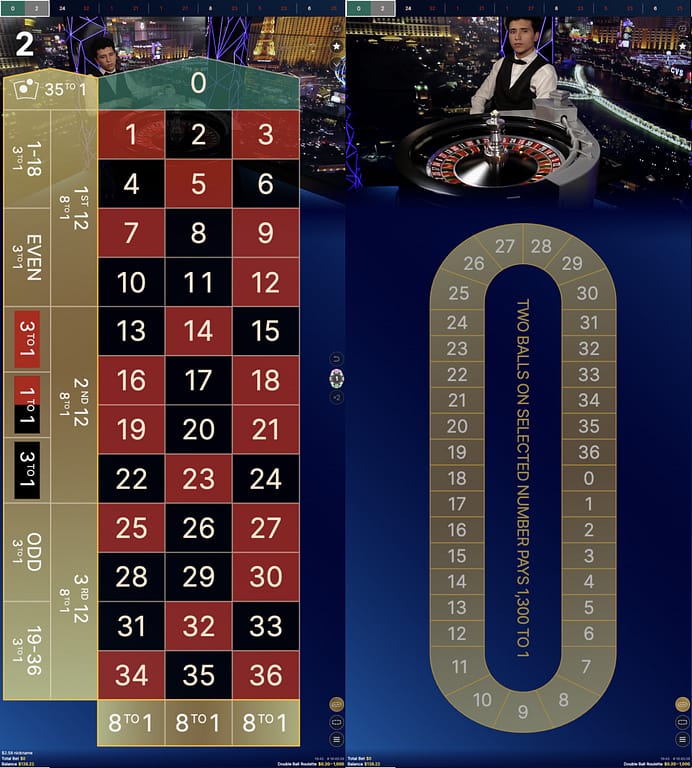
The Double Ball Jackpot (1,300:1) — The Maths
You pick a specific number — say 7 — and need both balls to land on exactly that number. There is only 1 winning combination out of 1,369. The payout is 1,300:1.
The jackpot is eye-catching but the math is unambiguous. A fair payout for a 1-in-1,369 event would be 1,368:1. By paying only 1,300:1, the casino keeps 68 units per 1,369 bets — a house edge of nearly 5%. Compare that to 2.70% on the “Any Same Number” bet, which also requires both balls to land on the same pocket — just without you having to predict which one. If you want to bet on the “double hit” novelty, the “Any Same Number” at 35:1 gives you far better value every single time.
Wait — isn’t 1,300:1 the payout when both balls hit your number?
Good question — and this trips up almost every new player. There are two completely separate bets that both involve balls landing on the same number, and they work very differently.
You place a chip on number 17 as normal. One ball hits → you win 17:1.
If both balls hit 17, the game automatically pays you twice — once for each ball. So you collect 17:1 + 17:1 = 34:1 total.
This is just a bonus on your existing bet. You do not need to do anything extra.
This is a separate side bet placed on the jackpot racetrack — not the main layout. You are specifically predicting that both balls will land on the same chosen number.
If they do: 1,300:1 payout. If only one ball hits your number, this bet loses — even though your straight-up bet would still win 17:1.
You place it separately and it costs a separate stake.
In standard European roulette, every bet carries an identical 2.70% house edge — whether you bet one number or 18 numbers. In Double Ball Roulette, this is no longer true for inside bets. The house edge increases as your inside bet covers more numbers.
Here is the intuition: when you bet a single number, the “double hit” bonus (both balls landing on your number) contributes meaningfully to your expected return because it doubles a 17:1 payout into a 34:1 win. When you bet a line of 6 numbers, the “both balls in zone” bonus is far more likely to occur but the doubled payout is only 4:1 instead of 34:1 — and the casino’s paytable does not adequately compensate for the extra win frequency. The result is a higher edge.
Straight Up: 2.78% → Split: 2.99% → Street: 3.36% → Corner: 3.87% → Line: 5.33%. Every step outward from a single number costs you more in expected value. This is the opposite of what most players instinctively believe.
💰 Full Payout & House Edge Table
The table below consolidates every available bet type, its winning condition, the payout, and the resulting house edge. Bets are ranked from best to worst RTP. All figures are for Evolution’s single-zero live version.
| Bet | Win Condition | Payout | RTP | House Edge |
|---|---|---|---|---|
| ⭐ Any Same Number | Both balls, same pocket | 35:1 | 97.30% | 2.70% |
| ⭐ Straight Up (1 no.) | Either ball on number | 17:1 / 34:1 (both) | 97.22% | 2.78% |
| Split (2 nos.) | Either ball on either number | 8:1 / 16:1 (both) | 97.01% | 2.99% |
| Street (3 nos.) | Either ball in row of 3 | 5:1 / 10:1 (both) | 96.64% | 3.36% |
| Corner (4 nos.) | Either ball in block of 4 | 3.5:1 / 7:1 (both) | 96.13% | 3.87% |
| Double Ball Jackpot | Both on selected number | 1,300:1 | ~95.03% | ~4.97% |
| Line (6 nos.) | Either ball in row of 6 | 2:1 / 4:1 (both) | 94.67% | 5.33% |
| Red / Black / Odd / Even | Both balls in zone (18 nos.) | 3:1 | 94.67% | 5.33% |
| Dozen / Column | Both balls in zone (12 nos.) | 8:1 | 94.67% | 5.33% |
| Red/Black Split (one each) | One red, one black ball | 1:1 | 94.67% | 5.33% |
✨ Special Bets in Detail
Beyond the standard roulette layout, Double Ball Roulette adds three unique betting options that you will not find in any other roulette variant. Two of them are connected to the “same pocket” novelty of the game; one is a near-miss curiosity.
This bet wins if both balls land in any identical pocket — you do not have to predict which number. With 37 possible “double hit” outcomes out of 1,369 total combinations, the probability is exactly 1/37 (2.70%), and the 35:1 payout mirrors the fair odds structure of a standard single-zero wheel. The result is the game’s lowest house edge at 2.70%.
This is the only bet in Double Ball Roulette that directly prices in the novelty of two balls, without over-charging for it. It is the closest thing to a “standard European roulette equivalent” that the game offers, and it should be a staple of any sensible session.
You nominate a specific number on the separate jackpot racetrack. Both balls must land on exactly that number. The probability is 1/1,369. The payout is 1,300:1 — which sounds spectacular until you realise a fair payout for those odds would be 1,368:1. The casino pockets the difference of 68 units per 1,369 bets, producing a ~5% house edge.
The key insight: the “Any Same Number” bet (35:1) and the Jackpot bet (1,300:1) both require the same mechanical event — both balls in the same pocket. The only difference is whether you predicted which pocket. You pay a premium of roughly 2.3 percentage points of house edge just for the privilege of naming the number. Use the jackpot bet as a one-unit lottery ticket if the thrill appeals to you, but never as a repeated core strategy.
This unusual bet wins when one ball lands on red and the other on black — i.e. the balls split between the two colours. It pays even money (1:1). There are 18 red and 18 black numbers, plus 1 zero. The number of “one red, one black” combinations is 18 × 18 × 2 = 648 (the ×2 accounts for either ball being the red one). Out of 1,369 total combinations, that gives a win probability of 648/1,369 = 47.3%.
At first glance this looks like a reasonable even-money bet — nearly a coin flip. But a 5.33% house edge is embedded in those numbers. By comparison, the standard Red bet in European roulette wins 48.6% of the time and carries only a 2.70% edge. The Red/Black Split sacrifices 1.3 percentage points of win frequency and gives you nothing back in payout, producing a worse gamble despite looking superficially similar.
Bottom line: if you want to use a progression system on a near-even-money bet, the Red/Black Split is the only 1:1 option in this game — but you are paying double the standard European edge to do so. There are better homes for progressive strategies.
🧠 Practical Strategy
Strategy in a game with a fixed house edge is largely about minimising that edge, managing variance to keep you in action longer, and avoiding the traps that the game’s unusual structure sets for unwary players. Here is a tiered approach based on the probability analysis above.
🥇 Tier 1 — The Core Strategy (2.70%–2.78% Edge)
Primary bet: Straight-Up numbers. Choose 1–5 numbers you want to back each spin and flat-bet them at your chosen stake. The 2.78% house edge is close to the European standard, and every spin carries the exciting possibility of a 34:1 double-hit if both balls share your number. Do not scatter chips across dozens of straight-up bets to cover more numbers — that does not change your edge, it just changes your volatility.
Supporting bet: “Any Same Number” at 35:1. This is the single best-value bet on the entire layout at 2.70% edge, and it complements straight-up betting neatly: you are already rooting for your numbers to double-hit, so the Any Same Number bet gives you a 35:1 win any time either ball double-hits anywhere on the wheel. A small fixed stake on this bet each spin adds a pleasant low-cost overlay to your session.
🥈 Tier 2 — Acceptable Supplementary Bets (2.99%–3.87% Edge)
Splits (2 numbers, pays 8:1): The 2.99% edge is a modest step up from the straight-up bet and still represents reasonable value. If you have two adjacent numbers you want to cover, a split is fine. The double-hit payout here is 16:1, which remains a worthwhile bonus.
Streets (3 numbers, pays 5:1): At 3.36%, you are now paying noticeably more than European roulette for the same coverage. Streets are acceptable as a minor portion of your bet mix but should not dominate your wagering. Avoid corners (3.87%) and certainly avoid lines (5.33%) — the edge deterioration from street to line is steep and unjustified by any meaningful improvement in win frequency that the payout compensates for.
🚫 Tier 3 — Avoid These Bets (4.97%–5.33% Edge)
All outside bets (Red, Black, Odd, Even, High, Low, Dozens, Columns): These carry a 5.33% house edge — nearly double European roulette. The “both balls required” condition obliterates the value. A Red bet in European roulette wins 48.6% of spins; in Double Ball Roulette the equivalent bet wins just 23.7% of spins, and the 3:1 payout does not make up the difference. Every 100 units you bet on outside bets costs you 5.33 in expected losses versus 2.70 in standard roulette.
Line bets (6 numbers): Despite being classified as an “inside” bet, the Line bet shares the same 5.33% house edge as the outside bets. The paytable for this bet is the worst on the inside grid. Avoid it entirely.
Double Ball Jackpot (1,300:1): With a ~5% edge, this is a pure lottery proposition. If you place one minimum-stake jackpot bet per session for the thrill of it, the expected cost is negligible. If you repeat this bet regularly at meaningful stakes, you are donating to the casino at nearly the worst available rate.
📊 Betting Systems — What Works and What Doesn’t
Betting systems are structured approaches to adjusting your stake size between spins — increasing after losses (negative progressions like Martingale and Fibonacci), decreasing after losses (positive progressions like Paroli), or making flat incremental adjustments (D’Alembert).
No betting system can change the house edge. Over a large number of spins, your expected loss is always (house edge) × (total money wagered), regardless of how you arrange your bets. What systems do affect is the distribution of outcomes: negative progressions reduce the frequency of net-loss sessions at the cost of occasional catastrophic losses; positive progressions let winning streaks run while capping losing streaks.
The critical question for Double Ball Roulette is: which bets are suitable foundations for these systems?
The Martingale doubles your stake after every loss, betting on an even-money outcome. On standard European roulette, the “even-money” Red bet wins 48.6% of spins. On Double Ball Roulette, the equivalent bet wins only 23.7% of spins. A losing streak of just 4–5 consecutive bets is far more likely than in standard roulette, and each doubled stake is larger in absolute terms because your losing run started sooner. Table limits are reached much faster. This is a significantly more dangerous strategy than it looks.
Example: Starting at £5, after just 5 losses you need to stake £160. After 7 losses: £640. Table limits at most casinos cut off progression well before recovery is possible.
Flat betting a fixed amount on 1–3 straight-up numbers every spin is the most mathematically defensible strategy. You are wagering at the game’s lowest edge (2.78%), your expected loss rate is predictable and manageable, and you maintain the upside of the occasional 17:1 or 34:1 payout that gives the session some excitement. Bankroll depletion is gradual and the session length is maximised for a given budget.
Example: £5 flat on two straight-ups = £10/spin. At 2.78% edge, expected loss per spin is approximately 28p. A £200 bankroll gives you roughly 700 spins of expected play before it is exhausted.
The D’Alembert increases stake by one unit after a loss and decreases by one unit after a win. It is gentler than Martingale and suitable for medium-variance bets. On a split (8:1 payout, 2.99% edge), the variance per spin is moderate enough that stake swings remain manageable over a realistic session. Set a strict ceiling — say, a maximum of 8 units above your base stake — and walk away if you hit it, regardless of the outcome.
Caution: The system does not offset the house edge. Over many sessions, the D’Alembert will produce the same total expected loss as flat betting the same total amount. Its only benefit is psychological smoothing of results.
All of these systems assume a near-50/50 base bet. In Double Ball Roulette, no bet offers those conditions at an acceptable edge. The Red/Black Split offers 47.3% win probability at 1:1 but carries a 5.33% edge — a terrible foundation. If you want to run Fibonacci or Labouchère, you would be better served moving to a standard European roulette table where the even-money bets carry only a 2.70% edge (or 1.35% with La Partage).
💼 Bankroll Management
Two balls per spin means more action, more frequent dramatic moments, and faster bankroll movement in both directions compared to standard roulette. A few principles specifically relevant to this game:
Choose your session budget, a loss limit (e.g. 50% of session budget), and a win target. Write them down or set deposit limits at the casino. Once hit, you leave — no exceptions.
Straight-up bets are high-variance (mostly losses, occasional big wins). A sensible rule: each straight-up stake should be no more than 1–2% of your session budget, so a normal losing run of 15–20 spins without a hit does not wipe you out.
The “2× Double & Spin” button doubles your previous bet and fires automatically — easy to tap when chasing a loss. Use “Rebet & Spin” for consistent flat-betting rather than impulsive doubling.
A practical worked example for a £100 session targeting long play: stake £2 on two straight-up numbers (£4 total per spin) plus £1 on “Any Same Number.” Total bet per spin: £5. At a blended house edge of roughly 2.80%, your expected loss per spin is about £0.14. Your session budget of £100 gives you approximately 700 expected spins before depletion — though of course variance means the actual figure will vary significantly above and below that. If either of your two numbers double-hits, you collect £68 profit on that spin alone.
Hot and cold number statistics displayed in the game interface are purely cosmetic. Each spin is independent — the wheel has no memory, and a number that has not appeared in 50 spins is not “due.” The probability of your chosen number hitting on any given spin is unchanged by its recent history.
📋 Quick Reference Cheat Sheet
- Straight-up numbers (17:1, 2.78% edge)
- “Any Same Number” side bet (35:1, 2.70%)
- Splits as secondary coverage (8:1, 2.99%)
- Flat betting to maximise session length
- Set loss limit before first spin
- Stake 1–2% of budget per straight-up
- Outside bets: Red, Black, Dozens (5.33%)
- Line bets — worst inside bet (5.33%)
- Repeating the 1,300:1 Jackpot (~5% edge)
- Martingale on outside or Red/Black Split
- Spreading inside bets to “cover more”
- Trusting hot/cold number displays
Bet single numbers and the Any Same Number side bet. Ignore everything in the outside betting zones. That is Double Ball Roulette strategy in a sentence.
⚠️ Gamble responsibly. No strategy eliminates the house edge — all figures above represent long-run expected outcomes and actual results will vary significantly in any single session. Figures apply to Evolution Gaming’s single-zero live version; land-based double-zero variants carry higher edges throughout. Minimum stake approximately £0.25; maximum stakes vary by operator. If gambling is causing you or someone you know concern, visit BeGambleAware.org or call the National Gambling Helpline on 0808 8020 133 (UK, free, 24/7).