Building a cryptocasino slot used to require a games studio, a regulatory licence, and years of development. Stake Engine changed that. The platform lets independent developers and content creators build and publish their own slot games directly onto Stake – and the people closest to it say the barrier to entry is lower than most people realise.
What Is Stake Engine?
Stake Engine is a development platform that allows third-party creators to build original slot games that run natively on Stake casino. The mathematics underpinning the games — the RNG, the house edge calculation, the payout mechanics — are handled by the platform. Developers build the concept, the frontend, and the visual experience on top of that foundation.
The result is that someone with frontend development skills and a good game concept can theoretically publish a slot without building the underlying gambling infrastructure from scratch.
How Long Does It Take to Build a Slot?
The honest answer is: it depends entirely on what you’re building.
Developers active in the space describe a wide range:
- A basic, functional slot with minimal polish can be completed in roughly a week
- A high-quality slot with strong concept, custom animations, features, and UI can take months
The week figure applies to what one developer described as “a shit slot” — something functional enough to publish but unlikely to attract sustained player interest. The months figure applies to anything genuinely competitive — a game designed to stand out in a library where players already have thousands of options.
The mathematics being pre-handled by Stake Engine is the key time saver. What takes the most time is everything else: game concept, visual design, animations, feature implementation, and the iterative testing required to make a slot feel good to play rather than just function correctly.
What Can You Earn?
Stake Engine offers developers two revenue models:
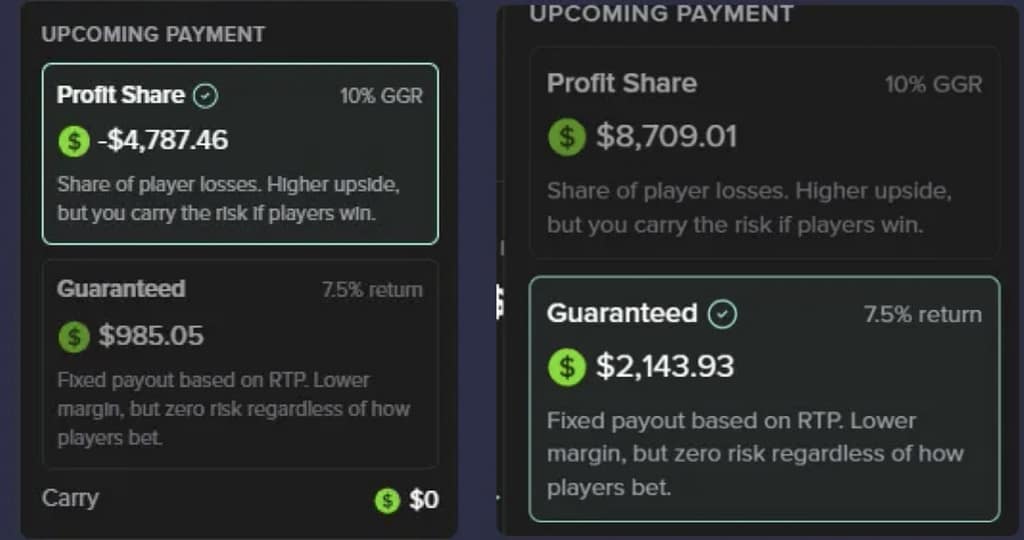
Profit Share – 10% GGR
You receive 10% of the house edge generated by your players’ losses. The upside is higher, but you carry the risk if players win – meaning your earnings can go negative. One developer dashboard screenshot shows -$4,787.46 in a single period, representing money owed back to Stake after players ran hot.
Guaranteed – 7.5% return
A fixed payout based on RTP, regardless of how players bet. Lower ceiling, but zero downside risk. Real dashboard figures from developers range from $116 to $2,143 per period.
The choice between models is a meaningful risk decision. The profit share model can theoretically generate significant income in losing periods for players — one dashboard shows $8,709 in a single cycle – but the same model can put a developer in the red when players win.
What the Top Games Actually Earn
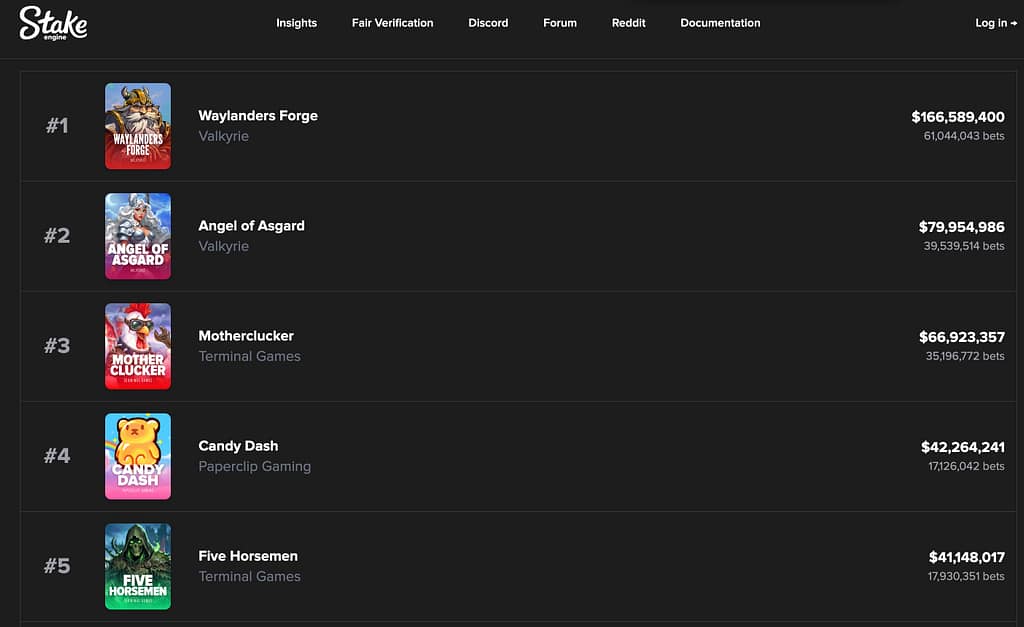
The Stake Engine leaderboard by 30-day wagered volume gives the clearest picture of what success looks like at the top end:
| Rank | Game | Developer | 30-day wager | Bets |
|---|---|---|---|---|
| #1 | Waylanders Forge | Valkyrie | $166,589,400 | 61,044,043 |
| #2 | Angel of Asgard | Valkyrie | $79,954,986 | 39,539,514 |
| #3 | Motherclucker | Terminal Games | $66,923,357 | 35,196,772 |
| #4 | Candy Dash | Paperclip Gaming | $42,264,241 | 17,126,042 |
| #5 | Five Horsemen | Terminal Games | $41,148,017 | 17,930,351 |
Waylanders Forge, the top-ranked game, processed $166,589,400 in wagers over 30 days against a 2.30% house edge — generating approximately $3.83 million in gross gaming revenue for the period. At the profit share rate of 10% GGR, that translates to roughly $383,000 to the developer in a neutral month. At the guaranteed rate of 7.5%, approximately $287,000.
These are the outliers, not the baseline. The top five games are pulling the majority of total platform volume, with the long tail of lesser-known slots doing a fraction of these numbers. A new developer entering the platform should benchmark against what a mid-table game generates, not what Valkyrie’s best title does after establishing itself.
The environment for new developers tightened further in mid-2026, when Stake Engine introduced an RTP ceiling of 96.70% for new submissions and began enforcing IP rules against games that too closely mirrored established titles. Full details here
The Opportunity — and the Reality Check
The appeal is straightforward. A successful slot on Stake generates passive GGR revenue for as long as it runs and players keep spinning it. For a content creator with an existing audience, a branded slot is also a marketing asset — something their community can play, share, and identify with.
The reality check comes from those who have tried. SureshKaBhai, a community member who attempted to build a slot using AI tools including Claude, described the result as “completely broken and not functional.” The observation was met with general agreement that building a genuinely good slot is harder than it looks from the outside — and that the difference between a slot that launches and a slot that anyone wants to play is significant.
One developer summarised it: “No shit everyone wants to dev a game nowadays with the bare minimum effort.” The Stake Engine infrastructure lowers the floor for what it takes to ship something. It does not lower the bar for what it takes to ship something good.
What You Actually Need
Based on what developers in the space describe, building a competitive slot on Stake Engine requires:
| What you need | Why it matters |
|---|---|
| A distinctive game concept | The library already has thousands of slots — generic doesn’t cut through |
| Frontend development skills | The UI, animations, and feel of the game are entirely on you |
| Design capability | Visual quality is one of the main things players judge immediately |
| Understanding of slot mechanics | Even with maths handled, you need to design features, multipliers, and bonus rounds coherently |
| Testing time | Slots need extensive play-testing before they feel right |
| Distribution plan | Building is only half the problem — getting players to find and try the game is the other half |
The last point is where content creators have a structural advantage over independent developers. A streamer with an existing audience can introduce a slot to thousands of players on day one. An unknown developer with no platform presence is starting from zero on both the game and the audience simultaneously.