- What is Fireball Roulette?
- How a Round Works
- Fireball Bonus Game in Detail
- Payouts, House Edge, and the Maths Behind Them
- RTP Comparison at a Glance
- Probability of Triggering the Bonus
- Strategy: How to Approach a Session
- The Core Approach: Hedge and Hunt
- Why Cluster Bets on the Wheel, not the Grid?
- Why Progressive Systems Don’t Work Here
- Three Practical Session Approaches
- Bankroll Management
- 9 Common Mistakes — And Why They Happen
- How Fireball Compares to Similar Games
- Summary: One-Page Cheat Sheet
How the game works, where every penny goes, and how to play it with your eyes open.
What is Fireball Roulette?
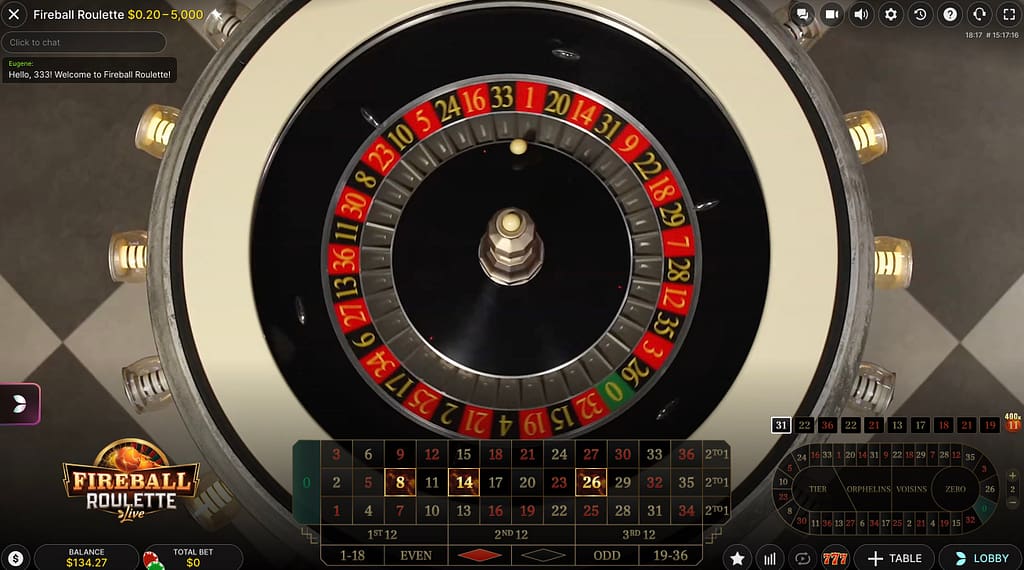
Fireball Roulette is Evolution’s live roulette variant, launched globally on 30 April 2025. On the surface it looks like a standard European roulette table — one green zero, 36 coloured numbers, and all the usual inside and outside bets. Under the surface it works very differently, because every single spin carries the possibility of a life-changing multiplier payout instead of the usual fixed odds.
The concept borrows from Evolution’s own Lightning Roulette (2018) but pushes the bonus size much further. Where Lightning Roulette caps multipliers at 500×, Fireball can reach 2,500×. The price you pay for that higher ceiling is a reduced base payout on single-number bets: instead of the classic 35:1, straight-up wins pay just 25:1 when no bonus is involved. That ten-point cut is the engine that funds the jackpot pool — and it is the single most important number to understand before you play.
In standard European roulette, a winning straight-up bet pays 35:1. In Fireball Roulette, the same bet pays 25:1 — unless it triggers the bonus, in which case it can pay anywhere from 30× to 2,500×. You are, in effect, surrendering 10 points of guaranteed payout every time your number comes in, in exchange for occasional access to a giant prize ladder. Whether that trade is worth it depends entirely on how you value volatility versus consistency.
How a Round Works
Each round in Fireball Roulette follows a clear sequence. Understanding it removes the confusion many players feel the first few times they watch the bonus trigger — or miss it by a fraction.
- 1
Betting window opens (~15 seconds)Place any combination of standard roulette bets using the grid or racetrack view. You can also toggle the Fireball Chaser at this stage — see the dedicated section below for a full explanation of what it costs and when to use it.
- 2
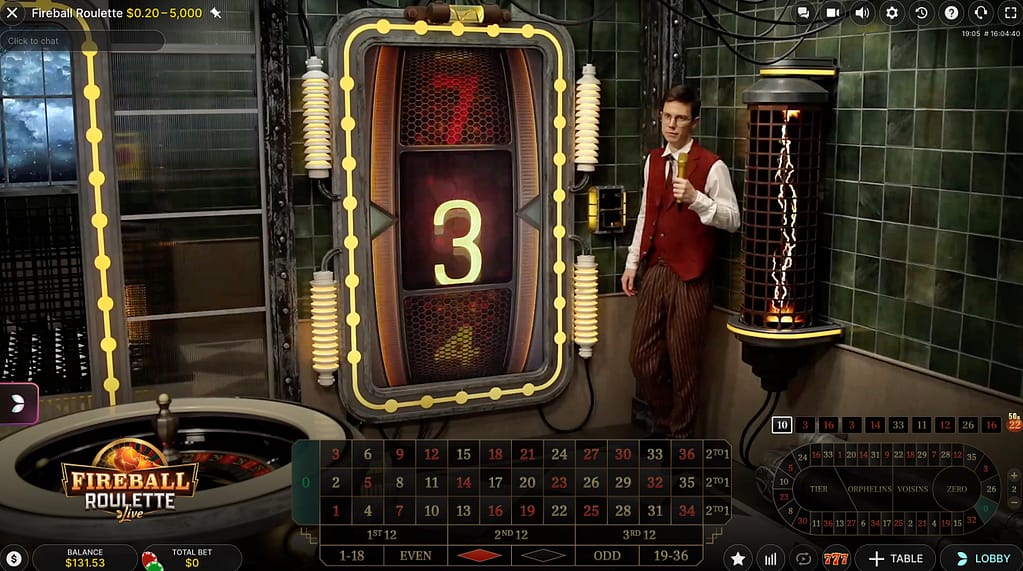
The dealer pulls the Fireball leverA single-reel slot machine beside the table stops on a number between 3 and 7. This is how many “Bonus Numbers” (also called Fire Numbers) will be randomly selected for this round — somewhere between three and seven of the 37 possible outcomes.
- 3
Fireballs strike the gridThat many positions on the betting layout are struck by animated fireballs. Some of the struck positions also reveal a mini-multiplier between 2× and 20×. These highlighted numbers are the only ones that can send you into the bonus game this round. If you don’t have a straight-up bet on at least one of them, the bonus is out of reach regardless of where the ball lands.
- 4
The ball spinsThe physical wheel spins normally. All standard wins pay out as usual. The one exception is straight-up bets: if your number wins but wasn’t a Bonus Number, you receive 25:1 instead of the classic 35:1. Outside bets are entirely unaffected by the Fireball mechanic.
- 5
Bonus triggers — or it doesn’tTwo things must both be true for the bonus to fire: (a) the winning pocket must be one of this round’s designated Bonus Numbers, and (b) you must have placed a straight-up bet on that exact number. If both conditions are met, you enter the Fireball Bonus game.
- 6
The bonus ball dropsA real ball drops into a physical 149-pocket enclosure. Land on a Regular pocket and you receive that multiplier applied to your straight-up stake. Land on a Double pocket and every Regular value doubles before the ball relaunches. Doubles can chain repeatedly until the ball finally hits a Regular pocket or the 2,500× hard cap is reached.
Fireball Bonus Game in Detail
The 149-pocket bonus enclosure is randomised freshly every round — the layout you see this spin will not be the same next spin. The grid contains two types of pocket:
Regular pockets carry multipliers ranging from 30× up to approximately 400–500×. When the ball settles in one, the game ends and you receive that multiplier times your straight-up stake. If your triggering Bonus Number also had a mini-multiplier attached (between 2× and 20×), the entire Regular multiplier is multiplied again before the cap is applied.
Double pockets — roughly five of the 149 slots — do not end the round. Instead, every Regular value on the grid immediately doubles and the ball is relaunched. This chain can repeat: a second Double doubles everything again, a third doubles it again, and so on. Because the Regular values start as high as 400–500×, a two-Double chain can push a high pocket well past the 2,500× hard cap, at which point the cap applies universally.
The 2,500× maximum requires a very specific combination of a high Regular pocket value plus one or more Double chains, or a large mini-multiplier on top of a high Regular result. In real play, the ball usually skips the Doubles entirely and settles in a Regular pocket in the 50–150× range. That is still a meaningful win on a straight-up bet — a £5 chip at 100× returns £500 — but it is a long way from the headline figure. Budget your expectations around the 50–150× range and treat anything higher as a bonus on top of the bonus.
Payouts, House Edge, and the Maths Behind Them
Before we get to strategy, it’s worth spending a moment on the actual numbers — because a lot of players skip this part and end up confused about why their session doesn’t match their expectations. The maths here is not complicated, and understanding it will make you a more confident player.
How House Edge Is Calculated
In European roulette every number has a 1-in-37 chance of winning. A bet that pays X:1 returns (X + 1) units when it wins and loses 1 unit otherwise. The expected value per unit staked is:
In Fireball, the straight-up payout is 25:1, not 35:1 (for non-bonus wins). Let’s recalculate:
That looks alarming, but it’s only the non-bonus result. The bonus exists to compensate. Evolution calculates the combined expected value — accounting for the probability and average size of bonus outcomes — and publishes the all-in RTP for straight-up bets as 97.00%, meaning a house edge of 3.00%. The bonus makes up for the reduced base payout, but only on average across millions of spins. In any individual session the bonus may never fire, which means you experience only the downside.
RTP is a long-run average. It is calculated across billions of spins and includes every jackpot ever paid. In a 100-spin session, the probability that you personally trigger the bonus even once is modest — depending on how many straight-ups you cover, it might be 20–40%. If you don’t trigger it, you have spent the entire session receiving 25:1 on a bet worth 35:1 in any other game. The 3.00% headline edge assumes the bonus is included in your results; in a short session where it never fires, your effective edge can be considerably worse.
House Edge by Bet Type
| Bet type | Numbers covered | Base payout | RTP | House edge | Notes |
|---|---|---|---|---|---|
| Straight Up | 1 | 25:1 (no bonus) 30×–2,500× (bonus) | 97.00% | 3.00% | Only route to bonus |
| Split | 2 | 17:1 | 97.30% | 2.70% | Standard European |
| Street | 3 | 11:1 | 97.30% | 2.70% | Standard European |
| Corner | 4 | 8:1 | 97.30% | 2.70% | Standard European |
| Line (Six-Line) | 6 | 5:1 | 97.30% | 2.70% | Standard European |
| Column / Dozen | 12 | 2:1 | 97.30% | 2.70% | Standard European |
| Red/Black, Odd/Even, High/Low | 18 | 1:1 | 97.30% | 2.70% | Standard European |
| Fireball Chaser side bet | All bonus numbers | Bonus only | 95.10% | 4.90% | Worst bet in game |
Notice something unusual here: in standard roulette every single bet shares the same 2.70% house edge. In Fireball, the straight-up bet is slightly worse (3.00%) than all the other inside and outside bets (2.70%). The reduced 25:1 base payout is not fully compensated by the bonus on a per-spin basis. This is the deliberate pricing decision Evolution made to fund the massive jackpots — and it is why a pure-maths player who doesn’t care about the jackpot should never play straight-up bets in this game.
Fireball Chaser: the Maths Explained
The Chaser is a toggle that, once activated, automatically places a straight-up bet of your chip size on every Bonus Number revealed each round. The cost is a flat 13.6× your chip, paid regardless of whether 3 or 7 Bonus Numbers appear. In exchange, you are guaranteed coverage of every potential trigger point.
Here is why the maths is unfavourable. Let’s say your chip is £1 and you activate the Chaser:
For comparison, if you flat-bet £5 per spin on Red/Black for 100 spins, your expected loss is just £5 × 100 × 2.70% = £13.50. The Chaser on a £1 chip costs you five times as much in expected losses as a £5 even-money bet. This is why it should only be used in short, deliberate sprints — not left on by default.
RTP Comparison at a Glance
The higher the bar, the more of your money is returned to you over time. Every gap between the bar and 100% is the house’s take.
Probability of Triggering the Bonus
This is the question every Fireball player should have a feel for before they sit down: how often can I realistically expect the bonus to fire?
The answer depends on two things: how many Bonus Numbers are selected this round (3 to 7, random), and how many of them you’ve covered with straight-up bets. Let’s work through the numbers.
Even at maximum coverage (all 7 Bonus Numbers, achieved only via the Chaser), the bonus still fires less than one spin in five. In a 100-spin session at average coverage, you’d expect roughly 13–14 bonus triggers. Over a shorter 30-spin session you might get two or three — or none. This volatility is entirely normal and should be factored into your session budget.
A Bonus Number is only “covered” if you have a straight-up bet on that exact pocket. An outside bet that includes that number — for instance, a Red bet when a red Bonus Number is drawn — does not qualify. The bonus trigger is strictly and only for straight-up bets. This is why outside-only players never see the bonus no matter how long they play.
Strategy: How to Approach a Session
Let’s be clear about something before we go further: no strategy changes the house edge. Every betting system — Martingale, Fibonacci, D’Alembert, Labouchère — has the same expected loss per unit as flat betting. They only change how your variance is shaped: some make losses slower and wins faster, others do the opposite. None of them make a negative-expectation game positive.
What strategy can do is help you manage your money sensibly, access the game’s most interesting feature (the bonus) without burning out too quickly, and make deliberate decisions rather than reactive ones.
The Core Approach: Hedge and Hunt
The most rational way to play Fireball Roulette is to combine a small straight-up presence (to keep bonus access open) with a stabilising outside bet (to slow down the bankroll drain during dry spells). Think of it as two parallel bets: a lottery ticket for the jackpot, and an insurance policy for the rest of the time.
For example: place 6 × £1 straight-ups clustered in one wheel sector, plus £5 on Red. The outside bet wins roughly 48.6% of spins and returns £10 when it does, which partially offsets the straight-up losses on those spins.
Why Cluster Bets on the Wheel, not the Grid?
Scattering straight-ups randomly across the layout costs exactly the same as clustering them into a tight sector — but clustering is more coherent. Use the racetrack view to cover Voisins du Zéro (17 numbers covering roughly half the wheel), Tiers du Cylindre (12 numbers on the opposite side), or any custom group of neighbours. When the ball runs hot through your zone, multiple wins arrive close together. When it runs cold, the dry spell is at least contained to a visible patch of wheel rather than random misses everywhere.
Why Progressive Systems Don’t Work Here
The Martingale — doubling your stake after every loss — is the most tempting system in roulette and the most dangerous in Fireball specifically. In standard roulette a Martingale on Red/Black is only moderately harmful because the base house edge is just 2.70%. In Fireball, if you’re running the Martingale on straight-ups, you’re doubling a bet with a 3.00% edge that pays 25:1 instead of 35:1 on non-bonus wins. The losing streaks are longer and more expensive than players anticipate. A six-loss streak starting from a £1 base requires a £64 stake on the seventh bet. Table limits — typically £500–£5,000 depending on the operator — cut the system off long before it can theoretically recover indefinitely.
On a Red/Black bet (18/37 chance of winning), you expect to lose roughly 6 spins in a row once every 85 sessions. On a single straight-up bet (1/37 chance of winning), you should expect to lose 20+ spins in a row every 2–3 sessions. Doubling down on a bet that wins less than 3% of the time will hit the table limit or exhaust a realistic bankroll long before the eventual win arrives.
Three Practical Session Approaches
4–6 straight-ups clustered in one sector at 1 unit each. One Dozen or Column bet at 2–3 units to stabilise. Chaser OFF. Designed for long sessions where the bonus is an occasional bonus rather than the main event. Best for players who want the full Fireball experience without aggressive variance.
8–10 straight-ups across one or two racetrack sectors at 1 unit each. One even-money bet at 3–5 units. Chaser activated only for a pre-budgeted 10–15 spin sprint after you’re up. Then switched off. The most popular approach — accesses the bonus regularly while keeping drain manageable.
12–16 straight-ups in a tight sector at 1 unit each. Chaser ON for a fixed 20–30 spin window only. No outside hedge — maximum bonus exposure. High burn rate. Only suitable with a ring-fenced budget you’re fully prepared to lose entirely. Not recommended for regular use.
Bankroll Management
Bankroll management is the single most impactful thing a roulette player can do. It doesn’t change the odds, but it determines whether a bad run of variance ends your session early or simply forms a small dip in a longer, more enjoyable experience.
- 1
Decide your session budget before you open the tableThis is money you are completely comfortable losing. It is not money you “expect” to get back. Once it’s in your head as already spent, you’ll make better decisions throughout the session.
- 2
Size your base unit at 1–2% of your session budgetFor a £100 session budget, your straight-up chips should be £1–£2. This gives you 50–100 spins before the budget runs out in a worst case, which is enough to expect several bonus triggers at average coverage.
- 3
Set a stop-loss and a stop-win before spinningA stop-loss of 50% of budget and a stop-win of 150% of starting stack is a common benchmark. When either is hit, you stop — no exceptions, no “just a few more.” The stop-win is just as important as the stop-loss: it forces you to bank a profitable session instead of giving it back.
- 4
Budget the Fireball Chaser separatelyAt 13.6× your chip per spin, a 20-spin Chaser sprint costs 272 units — nearly three times your chip budget for the whole session if you’re betting £1 chips. Allocate a specific pot for Chaser use and do not touch the main stack to fund it.
- 5
Bank big bonus wins and reassessAfter any bonus of 200×+, withdraw most of the profit and decide consciously whether to continue. The instinct to “run it” after a big hit is powerful — and it is the mechanism that returns most bonus money to the casino within minutes of being won.
9 Common Mistakes — And Why They Happen
- ✗Leaving the Fireball Chaser on every spin. It costs 13.6× your chip and has a 4.90% house edge. At £1 chips over 100 spins that’s £13.60 × 100 = £1,360 in total Chaser spending, with £66.64 in expected losses from the Chaser alone. Players leave it on because it feels like buying more chances — but those chances are expensive.
- ✗Expecting 35:1 on non-bonus wins. Many players trained on regular roulette instinctively feel underpaid at 25:1. That disappointment causes them to increase stakes trying to “make up the difference” — exactly the wrong response.
- ✗Using Martingale or aggressive doubling on straight-up bets. A single straight-up wins ~2.70% of the time. A six-loss Martingale run requires a 64× stake for a 1-unit recovery. The maths simply doesn’t work on a low-probability bet.
- ✗Believing outside bets can access the bonus. A Red bet covering a red Bonus Number does not trigger anything. Only a straight-up on that exact pocket qualifies. Newcomers regularly misunderstand this and leave disappointed when “their number” wins without triggering the game.
- ✗Scattering straight-ups randomly across the layout. 12 chips spread over 12 unrelated numbers is the same expected cost as 12 chips on a racetrack sector — but the sector approach creates more interesting patterns of wins and tells you at a glance whether the ball is visiting your zone.
- ✗Treating the 2,500× as a planning assumption. Most sessions end with zero or one bonus trigger, and most triggers pay 50–150×. If your session strategy only “works” at 500×+, you will be disappointed most of the time.
- ✗Chasing losses with the Chaser. Activating the Chaser mid-session to recover quickly is a classic loss-chasing pattern. It increases spending dramatically at exactly the moment your stack can least afford it.
- ✗Ignoring the stop-loss. “Just a few more to get back to even” is the thought that turns a £50 loss into a £150 loss. The stop-loss is not a suggestion.
- ✗Playing without understanding the 97.00% vs 97.30% distinction. The difference sounds trivial (0.30%). Over 1,000 spins at £5 per spin it represents an extra £15 in expected losses — the cost of the bonus access you’re paying for every time you bet straight-up.
How Fireball Compares to Similar Games
Multiplier roulette has become a genre of its own. Here’s where Fireball sits among its closest competitors:
| Game | Straight Up pays | Straight Up RTP | Max multiplier | Bonus trigger |
|---|---|---|---|---|
| Standard European roulette | 35:1 | 97.30% | None | N/A |
| Lightning Roulette (Evolution) | 29:1 | 97.10% | 500× | Straight Up on lucky number |
| Fireball Roulette (Evolution) | 25:1 | 97.00% | 2,500× | Straight Up on bonus number |
| Mega Fire Blaze (Playtech) | 29:1 | 97.10% | 10,000× | Any inside bet on lucky number |
The pattern is clear: a higher maximum multiplier always comes with a lower base straight-up payout and a slightly worse RTP on that bet. Fireball offers the best jackpot ceiling in Evolution’s roulette range, but it charges the highest cost for accessing it. Players who prioritise base value over jackpot size are better served by Lightning Roulette or standard European. Players who are specifically here for the biggest possible single win should consider Mega Fire Blaze Roulette alongside Fireball.
Summary: One-Page Cheat Sheet
- Cluster 6–10 straight-up bets in one wheel sector using the racetrack view — same cost as random placement, more coherent results
- Hedge with one even-money outside bet to slow bankroll drain during dry spells
- Use the Fireball Chaser only in short, pre-budgeted sprints (15–25 spins maximum), then switch it off
- Set a stop-loss and a stop-win before your first spin and honour both, no matter what
- After any bonus win of 200×+, bank most of the profit before continuing
- Size your straight-up chip at roughly 1–2% of your session budget so bad variance doesn’t cut the session short
- Remember the base straight-up pays 25:1 — keep your non-bonus win expectations calibrated accordingly
- Leaving the Fireball Chaser on every spin — at 13.6× and 95.10% RTP it is the most expensive bet in the game
- Running Martingale or any progressive doubling system on single-number bets
- Playing outside bets only and expecting to trigger the bonus — it is impossible without a straight-up bet on the winning pocket
- Building a session budget that only “works” if you hit 500×+ — plan for the 50–150× range
- Chasing losses by activating the Chaser mid-session to recover quickly
- Ignoring your stop-loss because you’re “close to even” — that logic never ends well
Fireball Roulette is an entertaining, well-engineered live game with a genuinely exciting jackpot mechanic. It is also a negative-expectation game where the house wins over time, and where the flagship bonus feature comes with a real cost attached. The players who enjoy it most treat it as what it is: a high-variance entertainment product with an occasional shot at a spectacular win. Go in with a clear budget, a plan for the Chaser, and realistic expectations about the bonus — and you’ll have a much better time than players who discover the 25:1 payout mid-session and feel cheated.