- 🎯 What Is Red Door Roulette?
- 🔄 How a Round Works
- 📐 The Maths: RTP, House Edge & What It Means for You
- 📊 Bets, Payouts & House Edge — Full Breakdown
- 🎡 Inside the Red Door — The Bonus Wheel Explained
- 🧠 Strategy Guide — How to Play Each Approach
- 💰 Bankroll Management — The Numbers That Matter
- 🚫 Common Mistakes & How to Avoid Them
- 💎 Practical Tips for Every Session
- 🔄 How Red Door Compares to Other Roulette Variants
- 🏆 The Bottom Line
🎯 What Is Red Door Roulette?
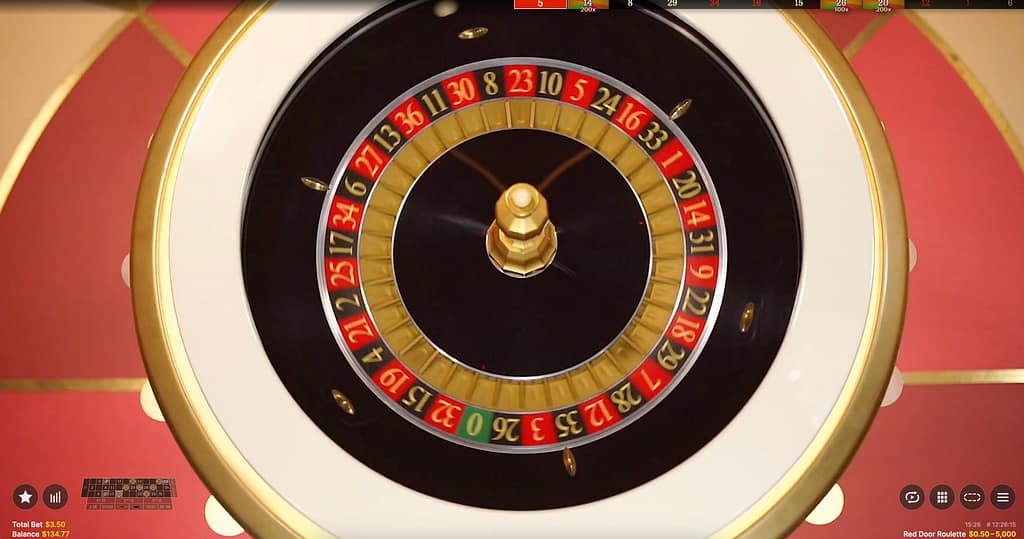
Red Door Roulette is Evolution Gaming’s boldest live casino hybrid, launched on November 8, 2023. At its core it is standard single-zero European roulette — the same 37-pocket wheel (numbers 0–36) you already know, with the same betting layout including inside bets, outside bets, and the full racetrack for called bets like Voisins du Zéro and Tiers du Cylindre.
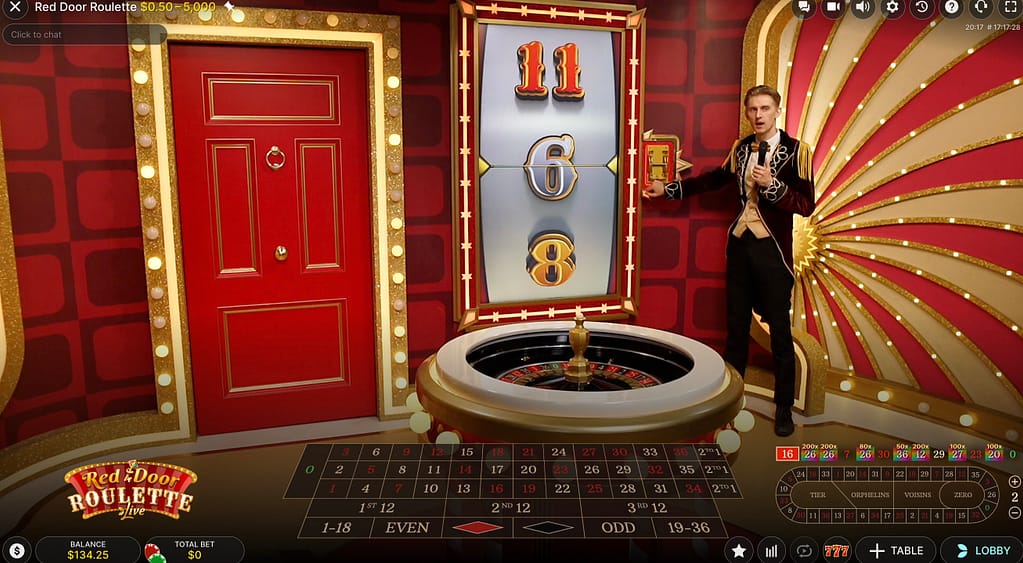
What makes it different is a two-layer bonus system bolted on top. Before every spin, a slot reel drops 3 to 15 “keys” onto randomly chosen numbers. Some keys carry a 2x–20x multiplier. If the ball lands on a key number that you have bet on straight-up, you step through the Red Door into a Crazy Time-style 64-segment bonus wheel where multipliers can compound up to a hard cap of 4,000x your stake.
The price of admission to that bonus, however, is real: straight-up bets pay only 19:1 instead of the standard 35:1 you’d get on a normal European roulette table. That 16-point reduction in base payout is how Evolution funds the multiplier and bonus mechanics. Everything else — outside bets, splits, corners, streets — pays exactly as it would on any European table.
Red Door Roulette = European Roulette + random key multipliers on straight-up bets + a Crazy Time bonus wheel you can only enter by hitting a keyed number. The base game is safe and familiar; the bonus is rare, volatile, and potentially enormous.
🔄 How a Round Works
Here is every stage in order:
- Outcome A — No bonus: The ball lands on a number that either has no key, or has a key but you didn’t bet it straight-up. All standard payouts apply — outside bets pay 1:1 or 2:1, other inside bets pay their normal rates. Straight-up wins on non-keyed numbers pay 19:1.
- Outcome B — Bonus triggered: The ball lands on a keyed number that you covered with a straight-up bet. You receive a base payout of 19:1 and the Red Door opens. Splits, corners, and streets on that number do not qualify — it must be a pure straight-up chip.
📐 The Maths: RTP, House Edge & What It Means for You
Return to Player (RTP) tells you how much of every £/$/€100 wagered will — on average, over millions of spins — be returned to players as winnings. It is a long-run theoretical figure, not a guarantee for any individual session. The flip side is the house edge: the percentage the casino keeps.
Take a £1 Red/Black bet. There are 18 red numbers, 18 black numbers, and 1 green zero — 37 pockets total. If you bet Red:
- You win £1 profit when any of the 18 red numbers land → probability 18/37
- You lose £1 when any of the 18 black numbers or the zero land → probability 19/37
Expected return per £1 staked = (18/37 × £2) + (19/37 × £0) = £36/37 = £0.9730
That is an RTP of 97.30% and a house edge of 2.70%. This is identical to standard European roulette — Red Door does not touch outside bet payouts at all. The same maths applies to columns, dozens, streets, corners, and splits.
On a standard European wheel, a £1 straight-up pays 35:1, so you receive £36 back (profit of £35 + your £1 stake). In Red Door it pays only 19:1, so you receive £20 back on a win. Here is the comparison:
| Game | Payout | Return on win (£1 stake) | Base RTP |
|---|---|---|---|
| European Roulette | 35:1 | £36.00 | 97.30% |
| Red Door Roulette | 19:1 | £20.00 | 97.09%* |
* The straight-up RTP in Red Door is 97.09% when the full bonus contribution is factored in by Evolution’s game maths. The base payout alone (without bonus) would deliver far less — the remaining expected value is carried by the keys and bonus wheel.
What this means practically: The “missing” 16 points of payout (35:1 → 19:1) are not simply taken by the house. They are redirected into the pool that funds multipliers and the bonus wheel. You are essentially exchanging a reliable, higher base payout for a chance at a much larger outcome. Whether that is a good trade depends entirely on your risk preference — not on pure expected value, which is almost identical.
This is the most important probability to understand when choosing how many numbers to cover. The formula is straightforward:
P(bonus on this spin) = (numbers you have covered straight-up ÷ 37) × (average proportion of those numbers that will be keyed)
Let’s use concrete numbers. Assume an average of 9 keys per round (midpoint of 3–15). The probability that any specific number you cover is keyed = 9/37 ≈ 24.3%. If you cover 13 numbers:
- Probability ball lands on one of your 13 numbers: 13/37 ≈ 35.1%
- Probability that specific number also has a key: ≈ 24.3%
- Combined (approximate) bonus probability per spin: ~35.1% × 24.3% ≈ 8.5%
- On average, roughly 1 bonus entry every 12 spins when covering 13 numbers
Cover only 3 numbers and that drops to roughly 1 bonus entry every 50+ spins. Cover 20 numbers and you approach 1 in 6–7 spins — but as the next section shows, covering too many numbers destroys your base-payout maths.
📊 Bets, Payouts & House Edge — Full Breakdown
Every available bet is listed below. The key point to remember: all bets except straight-up carry the standard European 2.70% house edge. The straight-up edge is marginally higher at ~2.91% because of the 19:1 payout reduction — but that edge figure includes the bonus value flowing back to players, so the real-world difference depends heavily on how often and how big the bonus pays in your specific session.
On a normal European table, a £1 straight-up bet on a single number returns £36 when it wins (£35 profit + stake). In Red Door it returns only £20 (£19 profit + stake). That is a £16 per-win reduction. Over 37 equal spins where each number lands once, you would win once and lose 36 times. On a European table that yields: (1 × £36) − (36 × £1) = £0 net (the theoretical break-even reflecting the 97.3% RTP). On Red Door: (1 × £20) − (36 × £1) = −£16 net — from the base game alone, without the bonus contributions.
This is why the straight-up bet in Red Door only makes sense as a bonus-chasing vehicle. The bonus must compensate for that structural deficit to make the RTP work — and over millions of spins, it does (hence the 97.09% figure). But in a short session where the bonus never fires, you will feel that payout cut acutely.
🎡 Inside the Red Door — The Bonus Wheel Explained
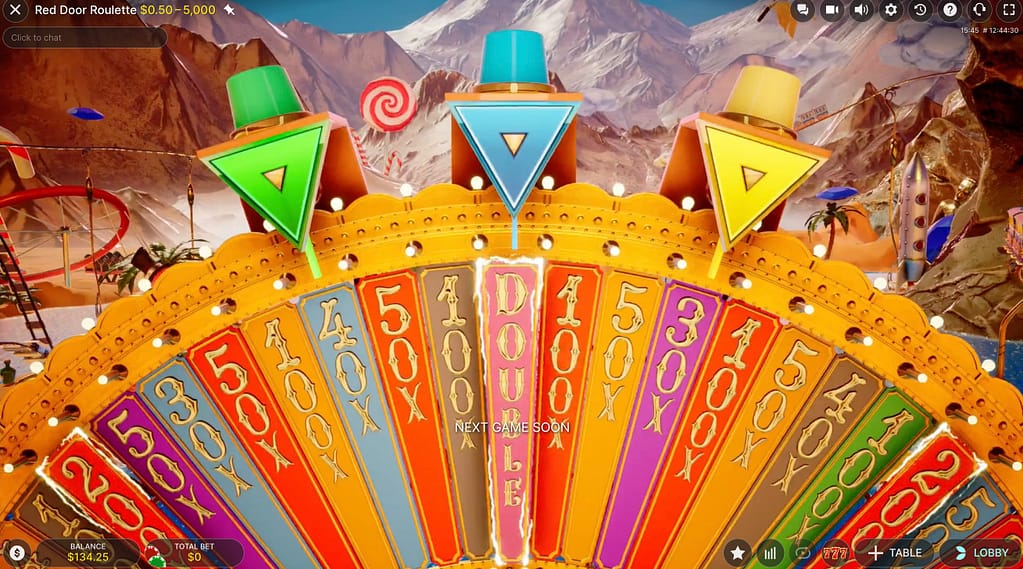
The bonus wheel is a 64-segment spinning wheel — the same visual format as the Crazy Time bonus game. Every qualifying player (those who had a straight-up bet on the winning keyed number) participates simultaneously.
How the key multiplier interacts with the wheel: If your winning key carried a multiplier — say 5x — then before the bonus wheel is spun, every multiplier value on all 64 segments is multiplied by 5. A segment that showed “10x” now shows “50x”. A segment that showed “100x” now shows “500x”. This pre-multiplication can dramatically shift the expected value of the bonus spin and is why high-value key multipliers are so exciting to land.
Setup: You place £1 on number 17 straight-up. The slot reel drops 10 keys; number 17 gets a key with a 5x multiplier. The ball lands on 17.
Base payout: You receive £19 + your £1 stake = £20 returned.
Bonus wheel pre-multiplication: Your 5x key multiplier is applied to the entire 64-segment wheel. Every value is ×5. A segment that said “40x” now shows “200x”.
Bonus spin result: The wheel spins and lands on a segment showing “Double”. All values double again (now ×10 from original). Wheel respins. This time it lands on a “100x” segment — which after the key and one Double is now showing 1,000x.
Final payout: £1 stake × 1,000 = £1,000 from the bonus alone, plus the £20 already paid from the base win. Total returned: £1,020 on a £1 stake.
🧠 Strategy Guide — How to Play Each Approach
Let’s be direct from the start: no strategy eliminates the house edge. Red Door’s edge is 2.70% on most bets and ~2.91% on straight-ups — those figures are baked into the game maths and cannot be overcome by bet selection, timing, or pattern recognition. What strategy can do is shape your volatility, control your burn rate, and maximise the number of genuine bonus opportunities you get for a given bankroll.
There are three meaningful approaches, defined by how many straight-up numbers you cover:
💰 Bankroll Management — The Numbers That Matter
Bankroll management is not about superstition or systems — it is about ensuring you have enough spins to give the statistical structure of the game time to play out, while protecting yourself from the ruin that comes from bad variance in a short session. Here are the concrete rules:
Starting bankroll: £150 | Strategy: 13 numbers at £0.50 each + £3 on a covering dozen = £9.50 total per round
Stop-loss: 25% of £150 = £37.50 max loss before stopping
Rounds before stop-loss: £37.50 ÷ £9.50 ≈ ~4 rounds minimum if every round is a complete loss (very unlikely but possible)
Realistic rounds: In most sessions you will win on your dozen bet roughly 1 in 3 spins and on a straight-up number roughly 1 in 3 spins. The actual bankroll burn is slower than worst-case. You might get 20–30 rounds comfortably on £150 at this stake level.
Takeaway: Lower stake + proper stop-loss = more rounds, more bonus chances, more entertainment. Never play at a stake level where 5 bad spins would break your session budget.
🚫 Common Mistakes & How to Avoid Them
Most mistakes in Red Door Roulette come from misunderstanding the maths or ignoring it in the heat of a session. These are the ones that consistently cost players the most money:
At 19:1, the math breaks at 20 numbers (£20 staked, £20 returned = zero profit before the house edge). Beyond 20, you are guaranteeing a loss even when you win a number. Many first-time players, excited by the bonus, spread chips across 25–30 numbers. With 25 numbers covered: stake £25, win £20, net −£5 every time you win. That is worse than just not playing. Keep coverage at 13–18 numbers maximum.
If you simply want to play individual numbers, standard European roulette pays 35:1 — nearly twice the base return. The 19:1 in Red Door is only worthwhile if you want the bonus. If you find yourself saying “I like betting single numbers but don’t care about the bonus,” switch games. You are paying a 16-point payout cut for a benefit you’re not using.
The bonus is statistically infrequent, and when it fires, it often pays modest amounts. Treating it as a “once it hits, I’ll be back to even” safety net leads to dangerous behaviour — increasing stakes to “catch up” before the bonus arrives. Mathematically, each spin is independent. Your current losses are irrelevant to what the next 10 spins will produce.
Martingale (doubling your bet after each loss) fails in all casino games because table limits cap how far you can go, and a losing streak of 7–10 in a row — which happens regularly over thousands of sessions — destroys the entire bankroll before the system can recover. In Red Door’s high-volatility environment, where 30+ losing spins in a row on your chosen numbers is not unusual, Martingale escalates to ruinous stakes terrifyingly quickly.
The game shows a stats panel of recent results and which numbers have appeared most/least frequently. This describes history — it tells you nothing about future spins. Each spin of a fair roulette wheel is statistically independent. A number that hasn’t appeared in 100 spins is no more likely to appear on spin 101 than any other number. The maths here is unambiguous: past results do not influence future outcomes on an independently randomised wheel. For a live view of which numbers carry a key and how long each number has been cold, see our Red Door Roulette live predictor and stats page
Red Door Roulette is certified by eCOGRA, licensed by the UKGC, MGA, and other regulatory bodies, and uses audited hardware. No app, APK, system, or paid “predictor” can influence or forecast its outcomes. Any website promising a guaranteed method, claiming to reveal the “dealer signature,” or selling a betting system is either misinformed or deliberately deceptive. The only edge available is understanding the maths and managing your bankroll accordingly.
💎 Practical Tips for Every Session
These are not strategies — they are practical habits that make your play more controlled and more enjoyable:
🔄 How Red Door Compares to Other Roulette Variants
Understanding where Red Door sits in the Evolution roulette lineup helps you decide whether it’s right for your playing style. The key comparison points are: straight-up payout, overall RTP, bonus structure, and volatility.
vs. European Roulette: Same wheel, same overall 97.30% RTP on outside bets, but straight-up pays 35:1 vs Red Door’s 19:1. If you don’t care about the bonus, European roulette is strictly better for straight-up play. European is also significantly less stressful — no slot reel, no key hunting, no 20-second countdown with complex chip placement.
vs. French Roulette with La Partage: La Partage returns half your stake on even-money bets when zero lands, cutting the even-money house edge to just 1.35%. This makes French roulette the best-value European-style roulette for even-money bettors — considerably better than Red Door for pure-value players.
vs. Lightning Roulette: Lightning applies random multipliers (50x–500x) directly to 1–5 numbers each round without a separate bonus round. The base straight-up payout is 29:1 (vs Red Door’s 19:1). Lightning feels less volatile than Red Door because multipliers fire more frequently, even if for smaller amounts — the bonus is inline rather than behind a door.
vs. Crazy Time: Crazy Time is a pure game show built around a spinning top segment wheel. It lacks the roulette structure but has four different bonus games and fires more frequent bonus rounds. Most consider Crazy Time less volatile than Red Door because the bonus is more accessible and varied. Red Door’s advantage is that it retains the full roulette betting structure — if you love roulette, Red Door fits naturally.
* La Partage halves even-money losses when zero lands, reducing the house edge on those bets to ~1.35%.
🏆 The Bottom Line
Red Door Roulette is a thoughtfully designed game that genuinely succeeds at what it sets out to do: bring the tension and entertainment value of a bonus game show into the familiar structure of European roulette. The maths are sound, the RTP is competitive, and the bonus mechanics are genuinely exciting.
The honest warning is that it is high volatility and the bonus is infrequent. Sessions without a single bonus trigger are normal and expected. The game rewards patience, proper bankroll management, and the clear-eyed understanding that the 19:1 straight-up bet is an entry ticket to the bonus — not a profitable bet on its own terms.
Red Door Roulette is a high-volatility game intended purely for entertainment. Always set strict time and money limits before you play. Use your casino’s responsible gambling tools — deposit limits, session time limits, reality checks, and self-exclusion options are available at all licensed operators. If gambling stops being fun, please contact GamCare, BeGambleAware, or the relevant support service in your country. Never chase losses. Past results do not predict future outcomes.