- Basics of European Roulette Strategy
- Top European Roulette Systems for 2024
- The Martingale Strategy
- The Fibonacci System
- The Paroli Strategy
- The Labouchere System
- The D’Alembert Strategy
- The James Bond Strategy
- Tips for Playing European Roulette
- Best Practices for Minimizing Losses
- Choosing the Right Table
- Managing Your Bankroll
- Understand Probability and Odds
- Tricks to Maximize Your Wins
- Additional Facts and Insights about European Roulette
- Expected Value and Long-Term Play
- Differences Between European, French, and American Roulette
- Historical Background and Evolution
- Famous Roulette Strategies and Their Origins
- Conclusion
European Roulette is a classic casino game that has captivated players for centuries. While luck plays a significant role, understanding strategies and systems can significantly improve your chances of winning. This comprehensive guide provides detailed insights into the best strategies, systems, tips, and tricks to help you master European Roulette.
Once you’re ready to put a strategy into practice, Evolution’s limited-edition World Cup Roulette is currently available at LTC Casino — a single-zero European Roulette table with a 2.70% house edge, ideal for any of the systems covered in this guide.
Basics of European Roulette Strategy
To develop a successful strategy for European Roulette, it’s essential first to understand the game itself. European Roulette features a wheel with 37 pockets, numbered 0 to 36. The presence of only one zero gives it a lower house edge (2.7%) compared to American Roulette, which has both a 0 and a 00.
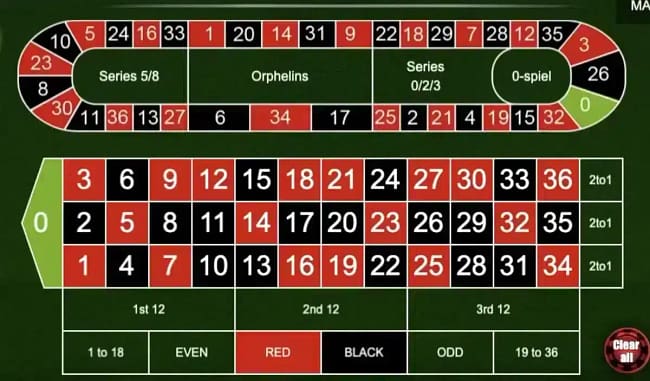
House Edge and Its Impact
The house edge is the mathematical advantage that the casino has over players. In European Roulette, the single zero contributes to the house edge, making it a more favorable option for players compared to other roulette variants. The house edge means that over the long term, the casino is expected to win 2.7% of all bets placed on the game. In our previous article, we explained the difference between American and European roulette and which roulette types has better odds.
Betting Options and Payouts
European Roulette offers a variety of betting options, each with its own payout and odds. Understanding these bets is crucial for any strategy:
- Inside Bets: Bets placed on specific numbers or small groups of numbers (e.g., straight-up, split, street). These offer higher payouts but lower odds.
- Outside Bets: Bets placed on larger groups of numbers or categories (e.g., red/black, odd/even, high/low). These offer lower payouts but higher odds.
Here is a table illustrating the odds and payouts for various bets in European Roulette:
| Bet Type | Payout | Odds |
|---|---|---|
| Straight Up | 35:1 | 2.70% |
| Split | 17:1 | 5.41% |
| Street | 11:1 | 8.11% |
| Corner | 8:1 | 10.81% |
| Six Line | 5:1 | 16.22% |
| Column | 2:1 | 32.43% |
| Dozen | 2:1 | 32.43% |
| Even/Odd | 1:1 | 48.65% |
| Red/Black | 1:1 | 48.65% |
| High/Low | 1:1 | 48.65% |
Top European Roulette Systems for 2024
Several betting systems have been developed to help players manage their bets and potentially increase their chances of winning. We included the most popular strategies, but there are also effective, though less common, strategies such as the Repeater Strategy. However, here are some of the most popular and effective systems:
The Martingale Strategy
The Martingale Strategy is one of the most well-known betting systems. It involves doubling your bet after every loss, aiming to recover all previous losses with a single win.
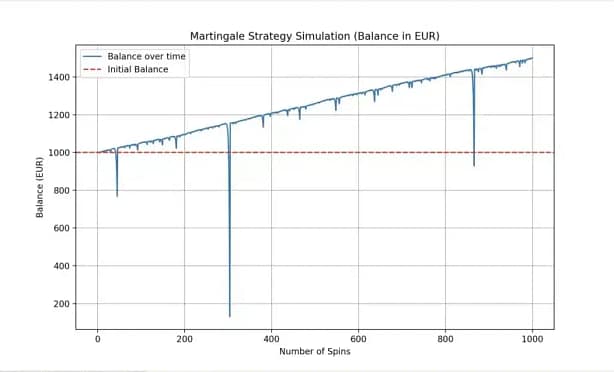
The plot above represents the balance over time when applying the Martingale strategy in a simulated game of European roulette over 1000 spins. Here’s a detailed analysis:
- Observations:
-
-
- The balance generally trends upwards, indicating that the player wins more often than they lose, or that the wins compensate for losses over time.
- Significant drops in balance occur periodically. These drops are due to losing streaks where the player has to double their bet multiple times. These large drops show the risk of substantial losses when employing the Martingale strategy.
- After each significant drop, the balance recovers, often surpassing the initial balance. This indicates that the Martingale strategy can recover losses if a win occurs after a losing streak.
- The balance stays above the initial balance most of the time, suggesting that in this particular simulation, the player did not lose all their money and ended up with a net positive balance by the end of 1000 spins.
-
2. Conclusion:
-
- The Martingale strategy can lead to large fluctuations in balance, especially after a series of losses.
- While it can result in a positive balance in the short term, the significant risk of large losses remains.
- The strategy’s effectiveness is heavily dependent on the player’s ability to sustain increasing bets during losing streaks.
- If you like how it works but want to try something different, you might consider one of the Martingale strategy alternatives also known as Debt betting system.
How It Works
- Start with a base bet.
- Double your bet after every loss.
- Return to the base bet after a win.
Pros and Cons
- Pros: Simple to understand and use, can recover losses quickly.
- Cons: Requires a large bankroll, can hit table limits quickly.
Example
| Bet Number | Amount | Spin Outcome | Profit |
|---|---|---|---|
| 1 | $2 | Lost | -$2 |
| 2 | $4 | Lost | -$6 |
| 3 | $8 | Lost | -$14 |
| 4 | $16 | Won | +$2 |
| 5 | $2 | Lost | -$2 |
| 6 | $4 | Won | +$2 |
Quick tip: You can run the Martingale simulation code for Roulette by yourself using the Google Colab file we shared with our readers. Additionally, you can easily edit the starting balance, bet size, and number of spins.
The Fibonacci System
The Fibonacci System is based on the famous Fibonacci sequence (1, 1, 2, 3, 5, 8, 13, …). In this system, each bet is the sum of the two previous bets.
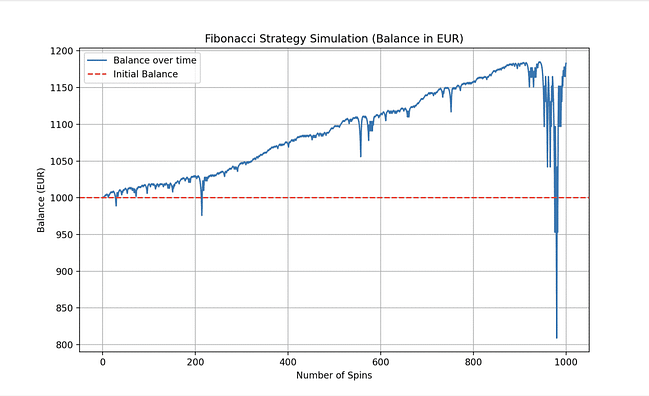
The plot represents the balance over time when applying the Fibonacci betting strategy in a simulated game of European roulette over 1000 spins. Here’s a detailed analysis:
- Observations:
- The balance generally trends upwards, indicating that the player wins more often than they lose, or that the wins compensate for losses over time.
- There are occasional significant drops in the balance, which are due to losing streaks where the player has to follow the Fibonacci sequence, increasing the bet size progressively.
- After each significant drop, the balance often recovers, suggesting that the Fibonacci strategy can regain losses if a win occurs after a series of losses.
- The balance stays above the initial balance for most of the simulation, indicating a net gain by the end of 1000 spins. However, there are moments when the balance drops below the initial balance, highlighting the inherent risk in the strategy.
- Conclusion:
- The Fibonacci strategy can lead to large fluctuations in balance, particularly after a series of losses.
- While the balance shows an overall upward trend in this simulation, the strategy is not without risk, as evidenced by the sharp declines.
- The effectiveness of the strategy relies on the player’s ability to sustain the increasing bet sizes during losing streaks.
This plot is a single instance of the simulation and results can vary widely with different runs due to the inherent randomness of roulette outcomes.
How It Works
- Start with a base bet.
- Follow the Fibonacci sequence for each bet after a loss.
- Move back two steps in the sequence after a win.
Pros and Cons
- Pros: Less aggressive than the Martingale, potentially smaller losses.
- Cons: Can still require a large bankroll, complex to follow.
Example
| Bet Number | Amount | Spin Outcome | Profit |
|---|---|---|---|
| 1 | $1 | Lost | -$1 |
| 2 | $1 | Lost | -$2 |
| 3 | $2 | Lost | -$4 |
| 4 | $3 | Won | -$1 |
| 5 | $1 | Lost | -$2 |
| 6 | $2 | Lost | -$4 |
| 7 | $3 | Won | -$1 |
| 8 | $1 | Won | $0 |
Quick tip: You can run the Fibonacci simulation code for Roulette by yourself using the Google Colab file we shared with our readers. Additionally, you can easily edit the starting balance, bet size, and number of spins.
The Paroli Strategy
The Paroli Strategy is a positive progression system where you double your bet after a win instead of a loss.
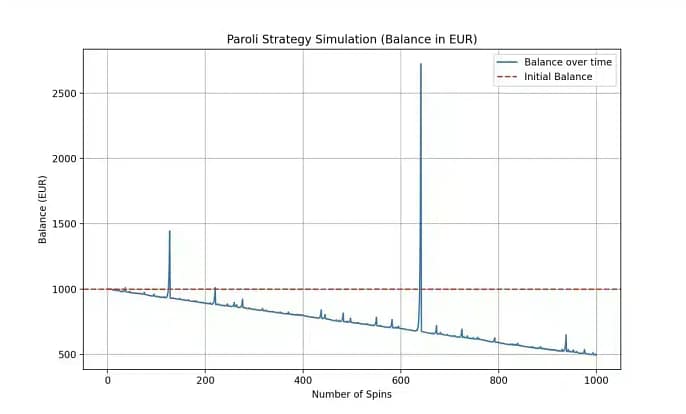
- Observations:
- The balance shows a general upward trend, indicating periods of winning streaks.
- Sharp increases in balance correspond to winning streaks where bets are doubled.
- Balance dips represent losses, after which the bet is reset to the initial amount.
- The balance stays above the initial balance for most of the simulation, suggesting net gains by the end of 1000 spins. However, there are occasional drops below the initial balance, highlighting the risks involved.
2. Conclusion:
The Paroli strategy aims to capitalize on winning streaks, resulting in sharp increases in balance during such periods.
- Losses are minimized by resetting the bet to the initial amount after each loss.
- While this simulation shows net gains, the strategy’s success depends on the occurrence and length of winning streaks, and results may vary with different runs.
How It Works
- Start with a base bet.
- Double your bet after each win.
- Return to the base bet after three consecutive wins.
Pros and Cons
- Pros: Limits potential losses, maximizes winning streaks.
- Cons: Requires discipline to stop after three wins, streaks can be short.
Example
| Bet Number | Amount | Spin Outcome | Profit |
|---|---|---|---|
| 1 | $1 | Won | +$1 |
| 2 | $2 | Won | +$3 |
| 3 | $4 | Won | +$7 |
| 4 | $1 | Lost | +$6 |
| 5 | $1 | Lost | +$5 |
Quick tip: You can run the Paroli simulation code for Roulette by yourself using the Google Colab file we shared with our readers. Additionally, you can easily edit the starting balance, bet size, and number of spins.
The Labouchere System
The Labouchere System, also known as the cancellation system, is a bit more complex but can be very effective.
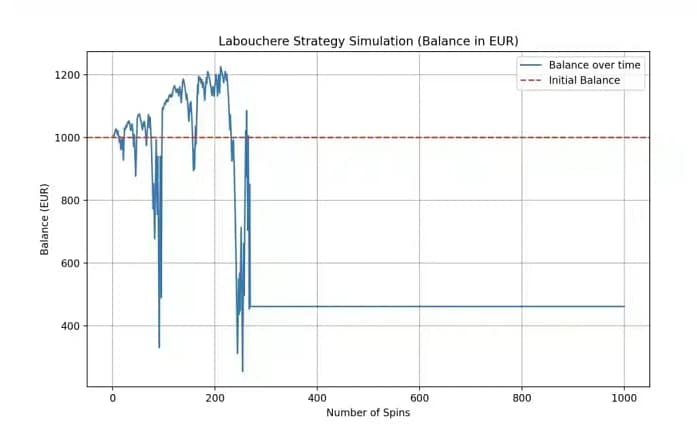
Conclusion:
-
- The Labouchere strategy demonstrates high volatility, with large swings in balance due to the nature of the betting sequence. Wins lead to balance recovery, but losses can quickly accumulate, leading to significant drops.
- The initial balance of 1000 EUR was insufficient to sustain the strategy over 1000 spins, as evidenced by the frequent depletion of funds. The strategy requires a substantial bankroll to withstand the inevitable losing streaks that result in large bet sizes.
- The Labouchere strategy is risky, especially for extended play sessions. While it can lead to periods of gains, the losses can be substantial and rapid, often leading to the depletion of the bankroll.
- The effectiveness of the Labouchere strategy is limited by the player’s ability to maintain a sufficient balance. Without a large enough starting balance, the strategy can lead to frequent bankruptcies, as shown in this simulation.
How It Works
- Decide on a sequence of numbers (e.g., 1, 2, 3, 4).
- Bet the sum of the first and last numbers in the sequence.
- If you win, remove those two numbers from the sequence.
- If you lose, add the amount you just bet to the end of the sequence.
- Repeat until all numbers are removed.
Pros and Cons
- Pros: Flexible and can be adjusted to personal preferences, potential for steady profits.
- Cons: Can lead to high losses if a losing streak occurs, requires careful tracking.
Example
| Bet Number | Sequence | Bet Amount | Spin Outcome | Profit |
|---|---|---|---|---|
| 1 | 1, 2, 3, 4 | $5 | Lost | -$5 |
| 2 | 1, 2, 3, 4, 5 | $6 | Won | +$1 |
| 3 | 2, 3, 4 | $6 | Lost | -$5 |
| 4 | 2, 3, 4, 6 | $8 | Won | +$3 |
| 5 | 3, 4 | $7 | Won | +$10 |
Quick tip: You can run the Labouchere simulation code for Roulette by yourself using the Google Colab file we shared with our readers. Additionally, you can easily edit the starting balance, bet size, bet sequence and number of spins.
The D’Alembert Strategy
The D’Alembert Strategy is a less aggressive negative progression system. You increase your bet by one unit after a loss and decrease it by one unit after a win.
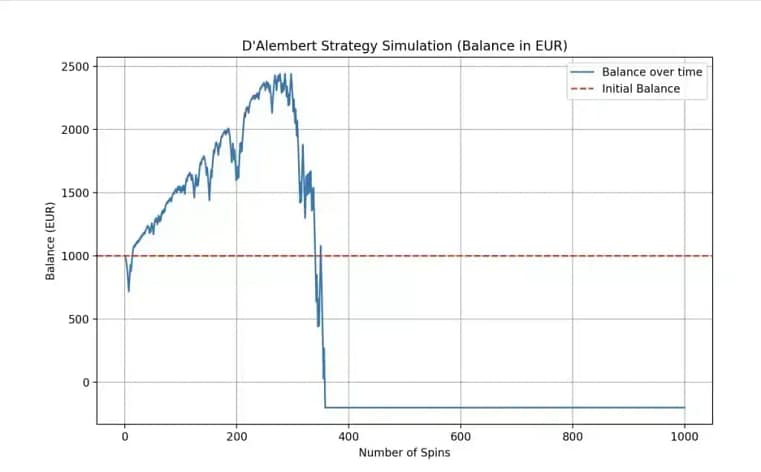
- Observations:
- The balance shows moderate fluctuations, with smaller peaks and troughs compared to more aggressive strategies like Martingale or Labouchere. This reflects the more conservative nature of the D’Alembert strategy.
- The balance generally trends downwards, indicating that while losses and wins are somewhat balanced, the player tends to lose more frequently over time.
- Periods of recovery are visible when the balance increases after a series of wins, followed by declines during losing streaks.
2. Conclusion:
-
- The D’Alembert strategy demonstrates moderate risk, with less severe fluctuations compared to other negative progression systems. It aims to balance wins and losses by adjusting the bet size incrementally.
- The strategy appears more sustainable over longer periods compared to more aggressive systems, but still tends to result in a gradual decline in balance.
- While the D’Alembert strategy can mitigate the impact of losing streaks, it is not immune to the house edge in roulette, leading to an overall downward trend in balance over time.
How It Works
- Start with a base bet.
- Increase your bet by one unit after each loss.
- Decrease your bet by one unit after each win.
Pros and Cons
- Pros: Less risky than Martingale, easier to manage bankroll.
- Cons: Slower recovery of losses, requires a higher win rate to be effective.
Example
| Bet Number | Amount | Spin Outcome | Profit |
|---|---|---|---|
| 1 | $5 | Lost | -$5 |
| 2 | $6 | Lost | -$11 |
| 3 | $7 | Won | -$4 |
| 4 | $6 | Lost | -$10 |
| 5 | $7 | Won | -$3 |
| 6 | $6 | Won | +$3 |
Quick tip: You can run the D’Alembert simulation code for Roulette by yourself using the Google Colab file we shared with our readers. Additionally, you can easily edit the starting balance, bet size, and number of spins. To unleash the potential of this strategy, use higher balance number.
The James Bond Strategy
The James Bond Strategy involves placing a combination of bets to cover a large portion of the wheel.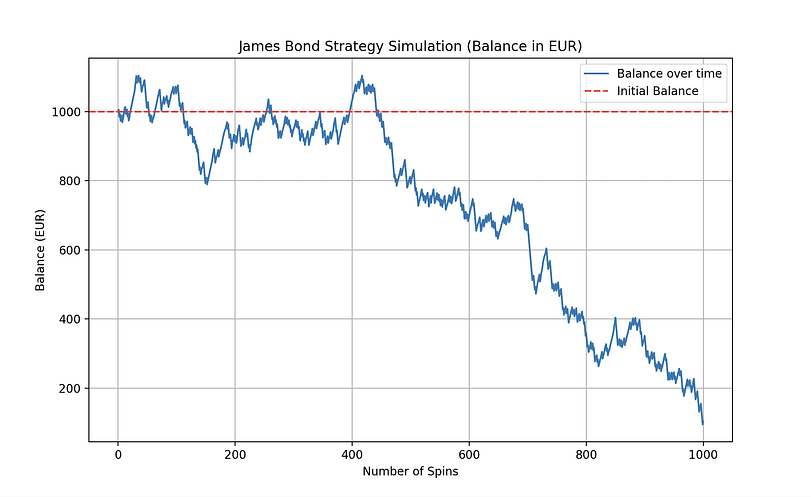
- Observations:
- The balance shows moderate fluctuations, reflecting the varied outcomes of the strategy’s spread of bets.
- The balance can increase significantly during winning streaks, particularly when high numbers (19-36) are frequently hit.
- The balance can also decline during losing streaks, especially when the outcome does not fall into any of the covered ranges (0, 13-18, 19-36).
- The strategy appears more sustainable over longer periods compared to more aggressive systems, but still tends to result in a gradual decline in balance due to the house edge.
2. Conclusion:
-
- The James Bond strategy demonstrates a balanced risk, with the spread of bets covering a significant portion of the roulette table. This reduces the frequency of losses compared to betting on single numbers or smaller groups.
- While the strategy can lead to periods of gains, the house edge in roulette means that the balance tends to decline over a large number of spins.
- The strategy is relatively sustainable over the short to medium term but requires a sufficient bankroll to manage the inevitable losing streaks.
How It Works
- Bet $140 on high numbers (19-36).
- Bet $50 on six numbers (13-18).
- Bet $10 on zero for insurance.
Pros and Cons
- Pros: Covers a significant portion of the wheel, potential for substantial wins.
- Cons: Requires a larger bankroll, risk of significant losses if the bet doesn’t hit.
Example
| Bet Type | Amount | Numbers Covered | Spin Outcome | Profit |
|---|---|---|---|---|
| High Numbers | $140 | 19-36 | 25 | +$80 |
| Six Numbers | $50 | 13-18 | 17 | +$100 |
| Zero | $10 | 0 | 0 | +$160 |
Quick tip: You can run the James Bond simulation code for Roulette by yourself using the Google Colab file we shared with our readers. Additionally, you can easily edit the starting balance, bet size, and number of spins. However, this strategy is rather for fun, as it doesn’t lead to huge winnings.
Tips for Playing European Roulette
Successful European Roulette play involves more than just strategies and systems. Here are some essential tips to enhance your gameplay:
Best Practices for Minimizing Losses
- Set a Budget. Determine how much you’re willing to lose and stick to it.
- Avoid Chasing Losses. Don’t increase your bets to recover losses.
- Take Breaks. Regular breaks help maintain focus and discipline.
Insert Image of Player Setting a Budget for Roulette here
Choosing the Right Table
- Check Table Limits: Ensure the table limits match your bankroll and strategy.
- Observe Before Playing: Watch a few spins to get a feel for the game.
Insert Image of a Roulette Table with Limits Displayed here
Managing Your Bankroll
Effective bankroll management is crucial in European Roulette, especially when dealing with high variance in bets.
Tips for Bankroll Management
- Divide Your Bankroll: Split your bankroll into smaller, manageable portions.
- Use Betting Limits: Set maximum and minimum bet limits to control your spending.
- Track Your Bets: Keep a record of your bets to monitor your progress and adjust your strategy as needed.
Quick tip: Having organized results can be a big part of your success. You can use the FREE Bankroll Managing Spreadsheet we created for our readers.
Understand Probability and Odds
Knowing the probabilities of different outcomes can help you make more informed betting decisions. Here are some common probabilities:
- Single Number (Straight Up): 2.70%
- Red/Black, Odd/Even, High/Low: 48.65%
- Dozen, Column: 32.43%
- Corner: 10.81%
Probability of Streaks
Understanding the probability of streaks can help you manage your expectations and strategy. Here is a table showing the probability of consecutive wins in European Roulette:
| Streak Length | Probability |
|---|---|
| 2 | 24.65% |
| 3 | 12.14% |
| 4 | 5.97% |
| 5 | 2.94% |
Tricks to Maximize Your Wins
If you don’t have time to use strategies, remember these simple tricks to decrease the house edge and improve your chances.
Leverage Casino Bonuses
If you play at a live dealer casino accepting Bitcoin, you’ll likely find bonuses and promotions. Utilize these bonuses to increase your bankroll and extend your playing time. However, if you like playing Live Roulette Games, you can’t use bonuses there.
Use Betting Tools and Software
Several betting tools and software can help you track your bets and analyze your gameplay. These tools can provide insights and help you refine your strategy. We added simulation scripts you can use to understand strategies usage, but before trying with real money, you can play crypto roulette games for free at our casino.
Practice with Free Games
Before playing with real money, practice with free European Roulette games. This allows you to familiarize yourself with the game and test different strategies without risking your bankroll.
Insert Image of an Online Free Roulette Game here
Additional Facts and Insights about European Roulette
Below are some interesting facts you may not know about roulette, which can be useful when applying betting strategies.
Expected Value and Long-Term Play
Expected Value (EV) is a crucial concept in roulette. It represents the average amount a player can expect to win or lose per bet over the long run. In European Roulette, the EV for a single number bet is calculated as follows:

This means that for every dollar bet, you can expect to lose about 2.7 cents on average.
Differences Between European, French, and American Roulette
Understanding the differences between these variants can help you choose the best game to play.
- European Roulette: 37 pockets (1-36 and 0), lower house edge (2.7%).
- French Roulette: Similar to European but with special rules like “La Partage” and “En Prison” that further reduce the house edge.
- American Roulette: 38 pockets (1-36, 0, and 00), higher house edge (5.26%).
- Double Ball Roulette: Same single-zero wheel but with two balls per spin, which changes the house edge on every bet type — see our Double Ball Roulette strategy guide
Historical Background and Evolution
Roulette, which means “little wheel” in French, has a rich history dating back to the 18th century. It evolved from various wheel games and gained popularity in the casinos of Paris. Over time, it spread across Europe and the Americas, leading to the development of different variants like European, French, and American Roulette.
Famous Roulette Strategies and Their Origins
- Martingale Strategy: Developed by French mathematician Paul Pierre Levy, this strategy became popular in the 18th century. It is based on the principle of doubling the bet after a loss to recoup losses and gain a profit.
- Fibonacci System: Named after the Italian mathematician Leonardo Fibonacci, this sequence-based strategy has been used in various gambling games, including roulette.
- James Bond Strategy: Named after the fictional spy, this strategy was popularized by Ian Fleming, the author of the James Bond novels.
Conclusion
Winning at European Roulette requires a combination of knowledge, strategy, and discipline. By understanding the game, using proven betting systems, and following practical tips, you can improve your chances of success and enjoy a more rewarding roulette experience. Remember, while strategies can enhance your gameplay, roulette is ultimately a game of chance, so always play responsibly.