Duel.com markets itself as “The 0% Edge Casino” — a bold promise in an industry where house edges typically range from 1% to 20% depending on the game and platform. The pitch is simple: play our originals and the house takes nothing. No hidden margins, no rigged math grinding you down over time.
But is it real? Or is it the cleverest marketing move the crypto gambling space has seen?
That question has been ripping through gambling communities, with streamers, affiliates, cryptocasino insiders and players all staking out positions. The debate cuts to the heart of how online casinos actually make money — and whether players are sophisticated enough to tell the difference between a genuinely fair product and a loss-leader funnel.
The Case For: Duel Really Is Different
The defenders of Duel’s model make a compelling mathematical argument.
The core of the platform’s originals — dice, plinko, crash, mines — are provably 0% house edge up to a $50,000 daily wagered limit. After that threshold, a small 0.1% edge kicks in. This is verifiable on-chain and through Duel’s published fairness documentation. It isn’t marketing copy. It’s math that can be checked.
On slots (third-party providers), Duel operates on a different structure: affiliates receive 70% of the casino’s edge after 50% is returned to the player as instant rakeback. In practical terms, if someone wagers $100 on a slot with a 4% house edge, $2 goes back to the player immediately, and $1.40 of the remaining $2 goes to the affiliate — leaving Duel with only $0.60. That margin is razor-thin compared to industry norms.
The sportsbook numbers are similarly aggressive: a 2% house edge on sports, with half going to affiliates, puts the effective margin Duel keeps at around 1%.
Backers of this model point out something obvious: if it were purely a gimmick, every other casino would have copied it already. They haven’t. Because running a casino on these margins is genuinely risky — and Duel’s founder, known as Monarch (who built his fortune through CSGOEmpire and smart crypto positioning), can absorb that risk in a way most operators cannot.
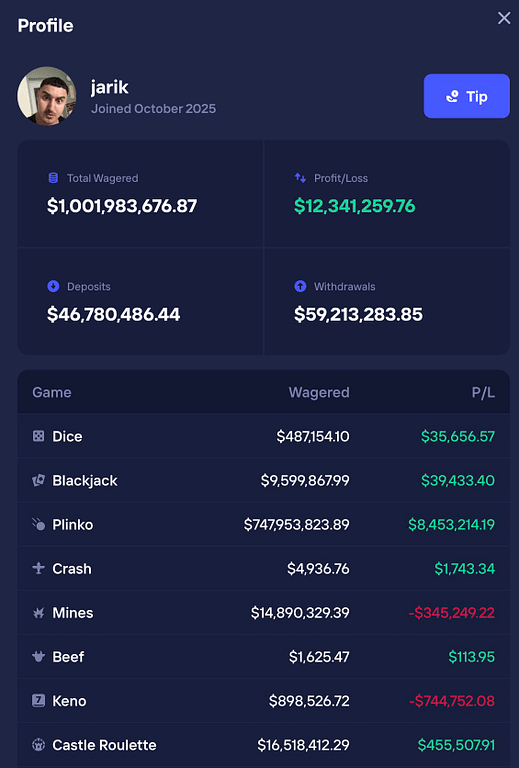
The proof of that risk came in a single player known as “jarik,” a highly skilled gambler who extracted millions from Duel by understanding the probability curves of their games at a level most players never approach. That kind of exposure is only possible at a casino willing to offer genuinely favorable odds. A scam site would have simply refused the withdrawals.
The Case Against: It’s a Funnel, Not a Charity
The skeptics, including some well-known streamers, aren’t convinced.
Their argument: the 0% edge originals are the front door. Once a player is on site, comfortable, and in a gambling mindset, they drift to the higher-margin products — slots from third-party providers, sports betting, live games. These carry real house edges, sometimes substantially higher. The originals, in this reading, serve the same function as a casino’s complimentary drinks: they’re not charity, they’re acquisition cost.
One prominent critic framed it this way: Duel doesn’t have 100% RTP “just to be nice.” There’s a business model underneath, and that model depends on players eventually moving to games where the house wins.
This isn’t a dishonest take. Duel does need revenue, and it does come from somewhere. The question is whether “funnel” is a fair characterization of the intent — or whether the structure still delivers better value than competitors even accounting for the higher-edge products.
The counter-argument from Duel’s defenders: even on slots and sports, Duel’s total rakeback and affiliate rewards structure returns more to the player than virtually any competitor. The 85% cumulative rakeback figure dwarfs the 20%-25% lossback offers that sound generous on rival platforms but attach hidden wager requirements, cashout caps, and fine-print conditions that evaporate most of the apparent value.
The Gamdom Comparison
One platform kept coming up as a point of comparison: Gamdom, which also advertises 100% RTP on its originals.
The distinction matters. Gamdom caps its 100% RTP offer at $5,000 in wagering — after that, the edge reverts to 1%. Duel’s $50,000 daily cap is ten times higher, and the post-cap edge (0.1%) is a fraction of Gamdom’s 1%.
The consensus that emerged: Gamdom is doing something superficially similar but materially worse for players. Duel’s model, whatever its marketing function, is objectively more favorable by the numbers.
The Rakeback Reality Check
But what does Roobet actually give back per $1,000 wagered on a slot like Le Bandit?
The answer, compared to Duel’s structure, is stark. Under Duel’s affiliate/rakeback system, a player wagering $1,000 on a typical slot (approximately 4% house edge) receives $20 back in instant rakeback. No hoops, no wager requirement, no monthly reset. The affiliate gets their cut. Duel keeps the sliver that’s left.
On most competing platforms, that same wager might generate a lossback offer — but only if you lose enough, only within a specific time window, only up to a certain cap, and only cashable after meeting additional wagering requirements on the money you receive back. The nominal percentage sounds similar. The real-world value is dramatically lower.
This is where the debate around “skilled gambling” becomes relevant. Many argue that playing on Duel — particularly the 0% originals — is the closest thing to +EV (positive expected value) gambling outside of poker or advantage play. The rakeback on other games, when calculated properly, brings the effective house edge low enough that disciplined players can extend their bankrolls significantly longer than on any rival platform. One player summed it up:
“If you play at Duel, you’re already more skilled than 90% of gamblers.”
The “Retard Mode” Factor
An upcoming Duel feature, referenced as “retard mode,” generates genuine enthusiasm from insiders.
The premise: a transparency tool that would let players see, in plain terms, how much other casinos are extracting versus what Duel takes. For players who’ve been operating on lossback deals they assumed were generous, the comparison is expected to be eye-opening.
One Duel employee put it bluntly:
“People who love bonuses are going to go absolute bananas when they see how much other casinos are robbing them.”
Whether the feature lands that way in practice remains to be seen. But the fact that Duel is building transparency tools — rather than hiding the math — is itself a data point in the debate about their intentions.
The Ossi Question
Behind the platform is Ossi — a figure who built significant wealth through CSGOEmpire, arguably one of the most successful skin gambling sites, before moving into crypto and arriving at Duel.
The debate about Duel is partly a debate about him. Skeptics point out that no billionaire starts a casino out of pure altruism. Defenders say the wealth is precisely the point: Ossi doesn’t need Duel to be maximally extractive. He can afford to run the lowest-margin casino on earth as a “passion project,” to disrupt a space he’s clearly spent years thinking about, and to earn the kind of goodwill and brand positioning that no advertising budget can buy.
Both things can be true simultaneously: Ossi built Duel to make money, and Duel is genuinely fairer than its competitors. The business model works not because it’s charity, but because fair odds attract serious, high-volume players — and serious high-volume players eventually generate enough aggregate revenue to sustain operations, especially at the top end where the wager caps no longer apply.
The Jarik situation illustrated this vividly. One skilled player extracting millions is the tail risk. The average player, even with favorable odds, still loses over time. The house doesn’t need a big edge when the volume is there.
What the Competitors Are Actually Doing
The conversation produced a catalog of behavior from rival platforms that contextualizes why Duel’s model generates such strong reactions — positive and negative.
- Stake raised house edges on its new originals from 1% to 2%.
- Winna was caught secretly changing plinko odds to be worse for players, then paying off people who called them out publicly.
- Metawin attempted to launch a memecoin that critics described as an attempt to extract value from their player base.
- MonkeyTilt deleted their entire originals library after being exposed for a fake provably fair system.
Against this backdrop, Duel’s approach — transparent math, instant rakeback, no cashout caps, no hidden wager requirements — looks less like marketing and more like a genuine structural difference.
The Bottom Line
The debate doesn’t resolve cleanly, because the two sides are often arguing past each other.
The skeptics are right that Duel isn’t running a charity. There is a business model. Revenue comes from slots, sports, and live games margins, and from the aggregate behavior of a large player base that will always, on average, lose.
The defenders are right that the structure is materially better for players than virtually every competitor. The math is public. The rakeback is real. The originals are genuinely 0% edge up to a meaningful daily limit. And the absence of the fine-print traps that make rival “bonuses” largely illusory is itself worth something.
The most honest framing might be this: Duel is the best casino deal in crypto gambling, and it’s also a casino. Both of those things are true. Whether you emphasize the first or the second probably depends on how much money you’ve lost elsewhere.