Rolly.io is a pre-launch crypto casino and sportsbook that’s generated more drama before opening its doors than most platforms manage in years of operation. It’s technically ambitious, visually polished, and sitting in the middle of a controversy that its own team has done almost nothing to clear up. If you’re a Luck.io refugee trying to figure out whether this is worth your time, or just someone curious about the next generation of crypto gambling, here’s everything you need to know.
Official Website
https://rolly.io/
What Rolly Actually Is
At its core, Rolly is trying to solve a real problem. Traditional online casinos — and most crypto casinos too — work like this: you deposit money, it goes into their account, and you just hope they give it back when you win. You’re trusting a company you know nothing about with your actual funds.
Rolly’s model is different. Your money goes into a smart contract, not a company wallet. Think of it like a digital safe deposit box at a bank — the bank built the vault, but only you have the key. Rolly can’t touch your funds, freeze them, or disappear with them. Even if the website goes dark tomorrow, you can still pull your money out directly from the blockchain.
This isn’t just marketing talk. It’s the same architecture that Luck.io used, and when Luck.io shut down in April 2026, every single player got their deposited funds back. The non-custodial model genuinely works.
On top of that, Rolly is building on its own ZK app chain. ZK stands for Zero Knowledge — it’s a way of proving something is true without revealing all the underlying information. In gambling terms, it means Rolly can prove every game result was fair without exposing the raw data that could be gamed. Game algorithms are published on GitHub, RTPs are verifiable on-chain, and there’s a public block explorer where anyone can check every bet, deposit, and withdrawal in real time.
The platform will support deposits in ETH, SOL, BNB, and TRX, with MetaMask, WalletConnect, Phantom, and TronLink all supported. You can also sign up with just an email, Google, X, or Discord — no wallet required, no KYC, no ID documents, ever. Even if you win big.
Early Rollers Race
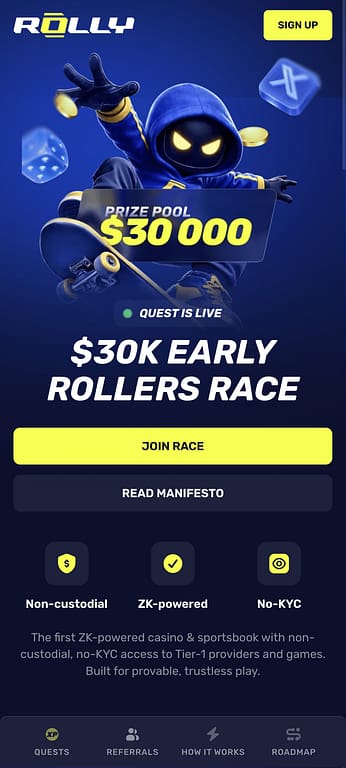
Rolly isn’t live yet as a casino. What’s running right now is a pre-launch campaign called the Early Rollers Race, with a $30,000 prize pool split between a $25K quest leaderboard and a $5K referral leaderboard.
The basic idea is straightforward. You complete tasks — follow Rolly on X, join their Telegram, read the manifesto, take a quiz — and earn XP points. More XP means a higher leaderboard rank, which means a bigger slice of the prize pool. There are 4 levels, each capped with a Soulbound NFT badge minted on-chain, and each badge unlocks more daily mini-game spins.
The quest design is actually well thought out. Tasks are sequential, verified automatically, and there’s a satisfying progression feel to it. Level 1 gets you into the community. Level 2 is about learning the platform. Level 3 involves getting your wallet scored. Level 4 is ambassador territory — creating content, promoting Rolly on social media.
There’s also a wallet scoring system worth understanding. At Level 3, Rolly evaluates your wallet’s age, transaction history, and asset diversity and gives it a score from 0 to 100. That score becomes a multiplier applied to all your XP. A score of 58 gives you a 1.45x multiplier. A score above 94 gives you the maximum 1.75x. Two players with identical activity can end up in very different positions on the leaderboard purely based on wallet history.
Here’s the thing about that. Rolly markets itself hard on privacy and no-KYC. But the wallet scoring system is essentially an incentive to hand over your entire financial history on-chain — every transaction, every asset, every protocol you’ve ever used — in exchange for a leaderboard boost. That’s not a privacy violation in the traditional sense, since blockchain data is already public. But it sits awkwardly next to the “we never collect your personal data” messaging.
The good news is you can switch wallets if your first one scores poorly, and the new multiplier applies retroactively to all your XP. So there’s no penalty for experimenting.
Prize distribution is heavily weighted toward the top. First place gets $2,500, second gets $1,250, and the rewards drop off sharply after that. Ranks 26 through 50 earn $32 each. Anyone past rank 100 in the referral leaderboard gets nothing. There are currently around 8,000 participants, so realistically most people will walk away with somewhere between $0 and $40.
One critical thing to know: after the race ends, you must claim an Early Roller ID during a specific claim window. If you miss it, your rewards are forfeit.
Rolly – Luck.io – Rollbit Connection
Luck.io was a Solana-based non-custodial crypto casino that processed over $1 billion in bets in under a year. It shut down suddenly in April 2026, honoring all fund withdrawals but voiding every accumulated reward — Gems, reload bonuses, loyalty benefits, all gone. Players who’d been grinding for months got their deposits back and nothing else.
On April 24, 2026 — the same day Luck.io announced its shutdown — Rolly posted a tribute tweet saying Luck.io “was one of the first to actually build on-chain gambling and make it feel like a product.” They listed what they claimed Luck.io got wrong: no Tier-1 providers, SOL-only deposits, and an on-chain story that “didn’t fully match the backend.” Then they positioned Rolly as the corrected version.
Two weeks later, on May 8, Rolly posted a professionally produced 10-second video targeting Luck.io users directly with the message “something is coming.” The video featured casino chips with a four-leaf clover design — Luck.io’s own branding — scattered across a desert road. The implication was unmistakable.
to all https://t.co/MhyL0OoDUq users…
something is coming. pic.twitter.com/hvJviw67s7
— Rolly (@rolly_onchain) May 8, 2026
The community reaction was fierce. Accusations flooded in that Rolly was the same team behind Luck.io, rebranding after voiding their users’ rewards and launching a new platform to monetize the same audience they’d just burned. The CEO’s response, posted on May 1, was that Luck.io’s shutdown “caught us off guard like everyone else, we weren’t building against it, we were just building.”
The team’s own manifesto describes themselves as “veterans behind one of the first crypto iGaming brands and DeFi products.” Rollbit, which is widely considered one of the earliest serious crypto iGaming brands, has been connected to Luck.io in the community for some time — never officially confirmed, but treated as an open secret. Rolly’s phrasing fits that description precisely. None of this is confirmed. But none of it has been denied either, and the silence is loud.
The question is whether they’ll honor their reward commitments this time, or whether the Early Rollers Race XP and prize promises will end up in the same bin as Luck.io’s Gems. The T&Cs don’t offer much reassurance on that front. Rolly reserves the right to modify, suspend, or terminate any quest or reward at any time without liability.
The Numbers So Far
After its first week, Rolly had 6,300+ users, 2,300+ active in the race, 85,500+ tasks completed, and 3,500 people on its first AMA. 83% of users came through referrals, spread across 90 countries. The launch tweet got 4,200 likes and 5,400 replies. The May 8 Luck.io tweet hit 21,000 views with 582 likes and 122 replies, the majority of which were skeptical or hostile.
That mix tells you something real about who’s paying attention. The hype is there, but so is serious skepticism from people who’ve been burned before.
Is Rolly.io a Scam?
The technology behind Rolly is genuinely interesting and addresses real problems in the gambling industry. Non-custodial fund storage, ZK-verified game outcomes, public bankroll transparency, and no-KYC access are all meaningful features if they deliver as promised. The platform hasn’t launched yet, so there’s nothing to actually play or test.
The pre-launch campaign is well designed and the $30K prize pool is real, but the realistic expected value for most participants is small, and the rewards are protected only by trust in a team that won’t confirm who they are.
If you’re considering joining the Early Rollers Race, the cost of entry is low — some social media tasks and a small amount of BNB for gas fees to claim badges. Getting involved early does carry potential upside if the platform launches successfully and the Early Roller benefits turn out to be meaningful.
But you should go in clear-eyed. The team is anonymous. The Luck.io connection is unresolved. The T&Cs give Rolly full discretion over rewards. And the platform itself doesn’t exist yet in any playable form.
The technology is promising. The trust has to be earned.