What is Red Baron?
Red Baron is a live-hosted “crash” game from Evolution Gaming, launched in November 2025. The theme is WWI aviation — a red biplane takes off and a multiplier climbs from 1.00× as it flies. Your job is simple: cash out before the plane disappears or you lose everything you bet that round.
What sets Red Baron apart from other crash games is that you can place up to three independent bets per round, each with its own cash-out target. This is more than Aviator (2 bets) and most rivals, and it is the core mechanic that all strategy in this game is built around.
There are two versions: a live-host version where a presenter in a pilot uniform hosts the action, and an RNG-only version. The host is cosmetic and has no effect on outcomes. Both versions use the same certified random number generator.
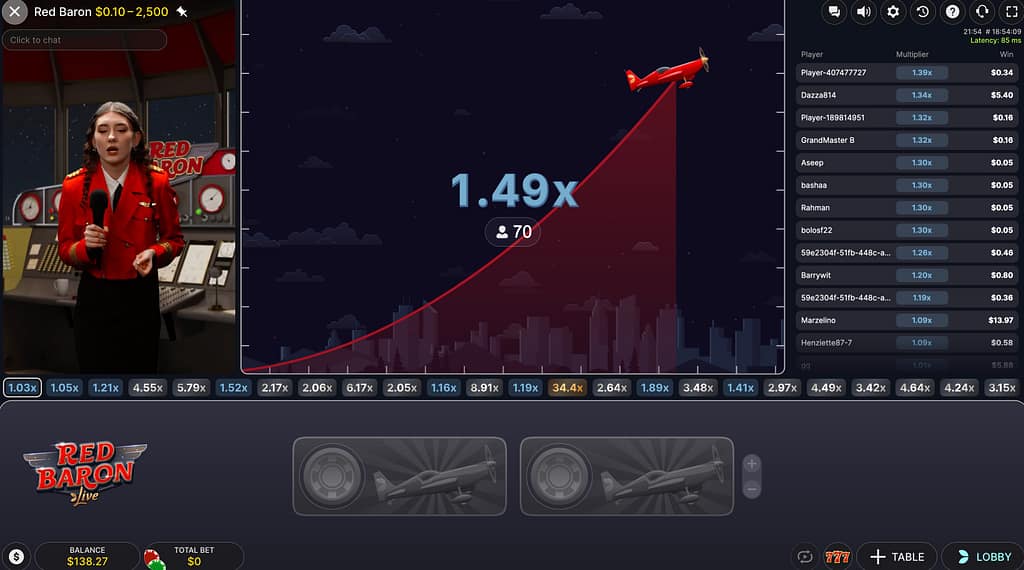
How a Round Works
Every round follows the same four-step cycle:
A brief betting window opens — roughly 10 seconds. Place 1, 2, or all 3 of your bets and optionally set an Auto Cash Out target for each one individually.
The plane takes off and the multiplier begins climbing from 1.00×. It might stop at 1.4×, or reach 800×. The RNG decides before the round even starts — the animation is a visual representation of a pre-determined result.
You click “Cash Out” on each bet manually, or the system does it automatically at your target. Each bet is settled independently — cashing out Bet 1 does nothing to Bet 2 or 3.
If the plane flies away before you cash out, that bet is lost. A new round begins almost immediately.
💡 Key rule: ties go to the house
If the plane crashes at exactly your Auto Cash Out target, the house wins and your bet is lost. Set your auto target slightly below your actual goal to avoid this. If you want to exit at 5×, set Auto Cash Out at 4.9×.
The Math — Understanding Your True Odds
This section matters. Understanding the math is what separates disciplined players from those who burn through their bankroll chasing losses.
House Edge and RTP
Red Baron has a 97% Return to Player (RTP). This means for every £100 wagered across many rounds, the game returns £97 on average and keeps £3. That £3 is the house’s guaranteed cut — it never changes regardless of what multiplier you target or what strategy you use. The house edge is simply 3%.
Compare that to European roulette (2.7%) or blackjack with basic strategy (~0.5%). Red Baron is not a low-edge game, but 97% is standard for the crash genre. Evolution’s own Cash or Crash game has a 99.59% RTP, which is meaningfully better if pure math is your priority.
House edge = 1 − RTP = 1 − 0.97 = 0.03 (3%)
Expected loss per £100 wagered = £100 × 0.03 = £3.00
Expected loss per £10 bet × 50 rounds = £10 × 50 × 0.03 = £15.00
Probability of Reaching a Given Multiplier
In a crash game with 97% RTP, the probability that the multiplier reaches or exceeds a value m follows a simple formula. You can use it to calculate the odds for any target you’re considering:
P(multiplier ≥ m) ≈ 0.97 / m

P(≥ 1.5×) ≈ 0.97 / 1.5  = 64.7%
P(≥ 2×)   ≈ 0.97 / 2.0  = 48.5%
P(≥ 3×)   ≈ 0.97 / 3.0  = 32.3%
P(≥ 5×)   ≈ 0.97 / 5.0  = 19.4%
P(≥ 10×)  ≈ 0.97 / 10   =  9.7%
P(≥ 50×)  ≈ 0.97 / 50   =  1.9%
P(≥ 100×) ≈ 0.97 / 100  =  0.97%
Each round is fully independent. There is no “due” multiplier, no hot or cold streaks. The probability of hitting 2× on the very next round is always ~48.5%, regardless of what just happened.
Hit Rate at a Glance
Three-bet Ladder — Red Baron’s Defining Feature
Most crash games give you one or two bets. Red Baron gives you three independent positions per round. This is far more than a gimmick — it fundamentally changes how you manage risk.
The idea of the “ladder” is to spread your three bets across different risk levels simultaneously. One bet is a safety net that cashes out early. One is a balanced, moderate target. One is a long-shot you mostly expect to miss, but when it hits it pays big.
Because all three bets run in the same round, you are not waiting three rounds to test three strategies. You run all three at once, every time.
Suggested stake split
Put the most on the safety bet and least on the moon-shot — for example £1 / £0.50 / £0.25. This way small wins come often and the occasional moon-shot is pure bonus. Equal thirds means you are spending as much chasing 10× as you are on near-certain 1.5× exits, which is poor value.
Alternative: Hedge Strategy
Set Bet A to auto cash out at 2× with a stake equal to your total combined wager. If it hits, Bet A covers everything you bet that round, so Bets B and C ride for free. Even if B and C both lose, you break even. If either hits, it is pure profit.
Bet A: £2 at 2× auto  → returns £4 if hit (covers all 3 bets)
Bet B: £1 at 6×       → profit if hit: £6 net
Bet C: £1 at 20×      → profit if hit: £20 net
Best case (A + C hit): £4 + £20 = £24 return on £4 staked.
Auto Cash Out vs Manual — Which Should You Use?
This is not a matter of preference — it is a meaningful mechanical difference that affects your results.
With Auto Cash Out, the server settles your bet the instant the multiplier reaches your target. There is no human reaction time. With manual cash out, you introduce roughly 50–150ms of latency on a good connection and 300ms or more on a poor one. In a game where the multiplier moves quickly, that gap matters.
There is also an emotional component. Players who cash out manually are far more likely to override their own plan. Holding on because “it feels like it’s going higher” is one of the most common ways people lose money in crash games. Auto Cash Out locks your target in before the round starts, when you’re thinking clearly.
✓ Auto cash out Recommended
No latency, no emotion, no second-guessing. The system is faster and more disciplined than any human. Set your targets before takeoff and let the game do the rest.
Manual cash out
Fine if you enjoy the adrenaline and have a stable connection. Be honest with yourself: are you likely to hold past your target when the multiplier looks “hot”?
Bankroll Management
This is the single most important topic in this guide. The math is clear: the house takes 3% of every pound wagered. Your bankroll shrinks over time — not always, not every session, but on average. Bankroll management does not beat the house edge. It makes sure you can stay in the game long enough to enjoy it and walk away on your terms.
Formula: Expected rounds = Bankroll / (Bet size × House edge)

£100 bankroll, £2 per round:  100 / (2 × 0.03) = ~1,667 rounds
£100 bankroll, £5 per round:  100 / (5 × 0.03) =   ~667 rounds
£50  bankroll, £1 per round:   50 / (1 × 0.03) = ~1,667 rounds

Note: variance means you can bust much faster or last much longer.
These are statistical averages, not guarantees.
Bankroll Rules of Thumb
- Never bet more than 1–2% of your session budget on a single round. A £50 session budget means a maximum of £1 per round.
- Targeting 10× multipliers? You need at least 30–50 losing units in reserve before your moon-shots start paying off statistically. At £0.50 per round that means a £15–£25 cushion.
- Set a stop-loss before you sit down. If you lose £X, you stop — no exceptions, no “one more round.” Chasing losses increases your total expected loss.
- Set a stop-win too. After a big hit the temptation to keep going is strong. Pre-decide: “If I am up £Y, I quit.” Walking away ahead is the only way to guarantee a winning session.
Common Mistakes — And What to Do Instead
⚠ Mistakes that cost players money
- Chasing the 20,000× ceiling. At roughly 0.005% probability per round you would expect to see it once every 20,000 rounds. Build your session around 2× to 10× targets instead.
- Using Martingale (doubling after each loss). A 10-round losing streak at 2× targets — which happens regularly — takes a £1 base bet to £512 per round. The system sounds logical and fails mathematically.
- Overriding your Auto Cash Out because other players are holding longer. Their cash-out history is purely social information. Past rounds have no predictive power over future ones. This is the gambler’s fallacy.
- Playing manual cash out on a bad connection. You will miss exits that Auto Cash Out would have caught. On a fast-moving multiplier, 300ms is the difference between profit and a total loss.
- Treating 97% RTP as a 97% win rate. A 97% RTP at a 2× target means you win ~48.5% of rounds and lose 51.5%. You will have long losing streaks. Budget for them.
- Betting equal stakes across all three bets. The 10× bet loses most often. Weight your stakes proportionally — largest stake on the safety bet, smallest on the moon-shot.
How Red Baron Compares
Red Baron vs Cash or Crash
Cash or Crash has a 99.59% RTP — nearly 3 full percentage points higher than Red Baron’s 97%. Over a 500-round session at £2 per round (£1,000 wagered), Cash or Crash costs you roughly £25 less in expected losses. If pure math is your priority, Cash or Crash is the better game.
Red Baron      (97.00% RTP): £1,000 × 0.0300 = £30.00 expected loss
Cash or Crash  (99.59% RTP): £1,000 × 0.0041 =  £4.10 expected loss
Difference: £25.90 — Cash or Crash is ~7× cheaper to play long-term
Red Baron vs Aviator
Both games run at 97% RTP so the house edge is identical. The key difference: Aviator allows 2 bets per round vs Red Baron’s 3. For players who use the three-bet ladder, Red Baron offers more structural flexibility. For casual single-bet play, the games are mathematically equivalent.
Community Verdict
Review scores are generally positive. Casinos.com rates it 8/10, praising production quality and the three-bet system. 10p Gamer gives it 6/10, noting it won’t replace Evolution’s biggest titles like Crazy Time but is “genuinely fun as a casual jump-in experience.”
The consensus: Red Baron is one of the most polished crash games released in 2025, worth playing if you enjoy the genre. It doesn’t beat the competition mathematically, but the three-bet system is a genuine strategic improvement for players who take it seriously.
Responsible gambling: Red Baron has a fixed 3% house edge that no strategy can eliminate. These approaches manage variance and session length — they do not change expected outcomes. Only gamble with money you can afford to lose. If gambling is causing harm, visit BeGambleAware.org or call the National Gambling Helpline.