- At a glance
- How the game works
- Runner tiers and odds
- Understanding the math
- What RTP Actually Means for Your Bankroll
- How Implied Probability Maps to the Odds
- Variance: Why Short Sessions Feel Very Different from the Math
- Betting strategies
- The Spread Approach — Recommended for Most Players
- Favourites-Only — Lowest Variance Approach
- Outsider Hunting — High Variance, High Reward
- Bankroll management — Units and Hard Limits
- Statistics tools in the game
- Common mistakes to avoid
An RNG-powered betting game where six runners race and you bet on which one wins. This guide explains exactly how the odds work, what the math looks like, and how to make smarter bets every round.
At a glance
How the game works
The Basic Loop
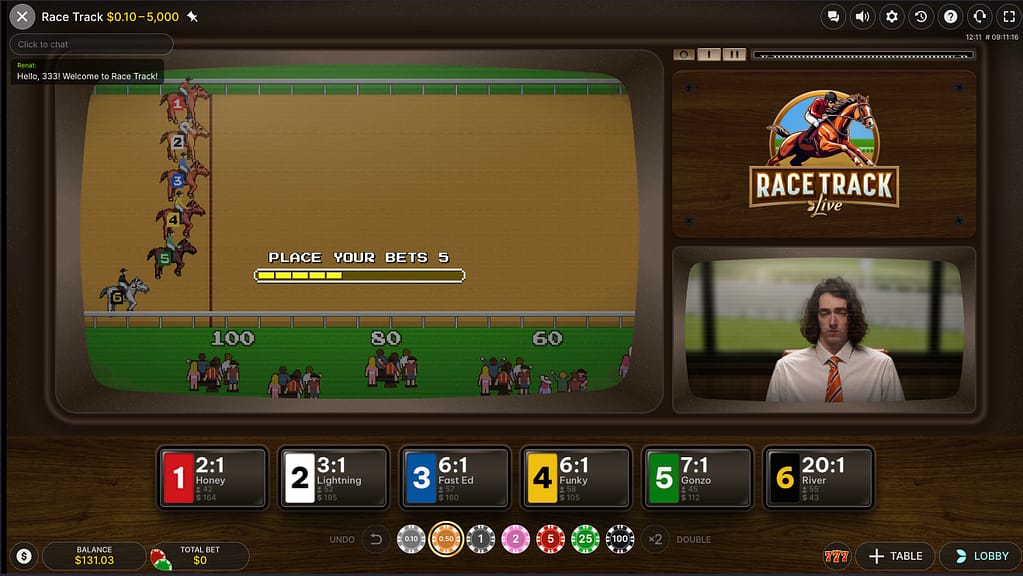
Before each race, six runners are randomly selected from a pool of 50 and placed in lanes 1–6 in descending order of strength — Lane 1 holds the favourite, Lane 6 holds the biggest underdog. A betting window of around 12 seconds opens. You pick which runner(s) you think will win and place your stake.
Once betting closes, the result is locked in by an RNG, and then an animated race plays out with a live presenter providing commentary. The animation is purely cosmetic — the winner is already decided the moment the betting window closes.
You can bet on more than one runner in the same race at different stake amounts. There are no side bets, bonus rounds, or special features — just a single Win bet per runner.
Two Themes, One Game
You can switch between Horse Mode and Dinosaur Mode at any time. The visuals change — in Dino mode, jockeys ride dinosaurs — but the odds, tiers, mechanics, and RTP are completely identical across both. Some casinos also run a host-free RNG variant alongside the version with a live presenter. All runner names reference other Evolution games and characters. The runner called Moon Shot carries the maximum 89:1 odds and always appears as an Outsider in Lane 5 or Lane 6 when drawn.
Runner tiers and odds
The 50 runners are divided into three tiers. Every race always draws exactly two runners from each tier, so the tier assigned to each pair of lanes is completely predictable before betting opens.
| Tier | Pool | Lanes | Odds | In plain English |
|---|---|---|---|---|
| Strong | 14 runners | 1 & 2 | 1:1 – 3:1 | Wins most often, pays least |
| Average | 17 runners | 3 & 4 | 4:1 – 15:1 | Moderate win rate, decent return |
| Outsider | 19 runners | 5 & 6 | 17:1 – 89:1 | Wins rarely, huge payout when it does |
Understanding the math
What RTP Actually Means for Your Bankroll
A 96% RTP means that for every $100 wagered over a long run, the game pays back $96 on average. The house keeps $4. This is a theoretical long-run average — it tells you nothing about what happens in a single session, but it sets the ceiling on expected value.
Expected value per $1 bet = $0.96 → house keeps $0.04 (4%)
For comparison: European Roulette runs at 97.3% RTP, and many blackjack games exceed 99% with optimal play. Race Track’s 4% edge is closer to a slot machine than a table game.
How Implied Probability Maps to the Odds
Each runner’s posted odds imply a win probability. A 1:1 (even money) bet implies a ~50% chance. A 3:1 implies ~25%. At the Outsider end, an 89:1 runner implies less than 2% chance of winning. These are the odds posted by the game — factoring in the house edge, the true probability is slightly lower still.
Implied probability = 1 ÷ (odds + 1) 3:1 → 1 ÷ 4 = 25% | 15:1 → 1 ÷ 16 = 6.25% | 89:1 → 1 ÷ 90 = 1.1%
Keep this in mind when spreading bets — you are paying a small premium (the house edge) over fair odds on every single bet you place.
Variance: Why Short Sessions Feel Very Different from the Math
RTP is a long-run figure. In 10–20 races, variance dominates — one Outsider win at 50:1 can look like a huge winning session even though the underlying edge favours the house. Conversely, backing Strong runners at 1:1 for 50 races might show a 20% loss before evening out. The shorter your session, the less the 96% RTP number matters and the more luck determines your result.
After N bets of $1: expected bankroll = $1 × 0.96^N (variance ± √N × σ)
This is why setting hard limits before you start — rather than relying on the RTP to “protect” you — is the only meaningful risk control available to the player.
Betting strategies
The Spread Approach — Recommended for Most Players
Instead of putting everything on one runner, split your budget across one runner from each tier per race. For example, if your unit for the round is $3, bet $1.50 on a Strong, $1.00 on an Average, and $0.50 on an Outsider. Here is what happens depending on which tier wins:
Strong wins
Lanes 1–2Roughly breaks even — the 1:1–3:1 payout covers the two losing bets
Average wins
Lanes 3–4Small net profit — 4:1 to 15:1 easily covers the two losing bets
Outsider wins
Lanes 5–6Large profit — even a small stake at 17:1+ more than covers everything
The spread does not change the house edge — you are still giving 4% to the house per dollar wagered. What it does is reduce the chance of a session-ending losing streak by ensuring every race result pays out something.
Favourites-Only — Lowest Variance Approach
Backing only Lane 1 or Lane 2 (Strong runners at 1:1 – 3:1) gives you the highest win frequency. You will win roughly half your bets or more, which makes your bankroll decline slowly and makes long sessions possible on a modest budget. The tradeoff is that a 1:1 payout barely keeps pace with losses — after the house edge, you net roughly $0.96 per dollar wagered over time.
At 1:1 odds with 96% RTP: expected $1 bet returns $0.96 → net −$0.04 per race
Best for: players who want to play for entertainment over a long session without risking a big drawdown.
Outsider Hunting — High Variance, High Reward
Betting small exclusively on Lane 5 or Lane 6 Outsiders is a high-risk approach. The implied win probability is under 6% (1-in-17 at minimum odds), meaning long losing streaks are completely normal. However, a single hit at 50:1 or 89:1 can more than repay dozens of losing races.
At 17:1 odds → expected win rate ≈ 5.6% → roughly 1 win every 18 races $1 stake at 50:1: lose 49 races (−$49), win 1 (+$50) → net +$1 over ~50 races
Best for: players comfortable with a long cold streak who are aiming for a single big payout. Budget for at least 30–50 losing races before expecting a win.
Bankroll management — Units and Hard Limits
Divide your session bankroll into small equal units before you start. A common approach is 1–2% of your total bankroll per unit. This means a string of losses cannot wipe you out quickly. Set a loss limit and a win lock before opening the game — RNG games have no “due” wins, so there is no mathematical reason to push through a losing streak.
Recommended unit size: 1–2% of session bankroll per race Loss limit: −15% to −20% of session start → stop for the day Win lock: bank at +20% → do not re-invest profit in the same session
Autoplay can help enforce discipline here — because tiers always occupy the same lane positions, a fixed autoplay bet pattern removes the temptation to impulsively resize stakes mid-session.
Statistics tools in the game
All Horses / All Dinos View
This shows how each of the 50 runners has performed over the last 100 races versus their theoretical win probability. It is useful background context, but because each race result is an independent RNG event, a runner that has won more than expected over the past 100 races is not more likely to win the next race. The probabilities are completely reset every race.
Tipster’s Choice View
Highlights the runner that has returned the highest RTP over the previous 50 races — effectively pointing at whichever runner has been “overperforming” recently. This is reflective data only. One big Outsider win can inflate a runner’s displayed stats dramatically, making it look hot when it is just the result of a single fortunate draw. Do not use it as a predictive signal.
Common mistakes to avoid
Chasing losses with Martingale. Doubling your stake after each loss sounds logical — in theory you recover everything with one win. In practice, five or six consecutive losses (completely normal with Outsiders) can multiply a $1 starting bet to $32–$64, and you will hit the table limit before you can recover. The house edge compounds with every bet.
Treating streaks as signals. A runner that has won three races in a row is not “on a roll” — the RNG has no memory. Its odds next race are exactly the same as they were before those three wins. This is the gambler’s fallacy and it is the single most common cognitive trap in RNG games.
Underestimating the house edge cost. 4% per dollar wagered feels small, but over 100 races at $5 per race you have wagered $500 and the expected loss is $20 — before variance. Treat the house edge as an entertainment cost you are accepting each session, not something that skill or strategy can overcome.
Resizing stakes mid-session. Increasing bets to “get it back” after a losing run is the fastest way to blow a bankroll. Your unit size should be set before the session starts and adjusted only when your total bankroll has meaningfully changed — not in response to the last few results.
Expecting better RTP than it offers. At 96%, Race Track’s return is comparable to a slot machine. European Roulette runs at 97.3% and blackjack can exceed 99.5% with optimal play. If maximising expected return matters to you, Race Track is not the most efficient choice.
The Bottom Line
Race Track is an entertaining, fast-moving game with transparent mechanics and clearly published odds. The 96% RTP is honest, the three-tier system is easy to understand, and the spread approach is a sensible way to manage variance across a session. No strategy can overcome the 4% house edge over the long run — but smart bankroll management, hard session limits, and a clear understanding of the math will make your play more consistent and extend your enjoyment. Play for fun, set your limits before you start, and walk away when you hit them.