If you spend time in gambling streamer communities, you’ll hear a lot of talk about “deals” – but rarely a clear explanation of what they actually mean. Here’s a plain breakdown of how the affiliate deal ecosystem works.
Deal Types
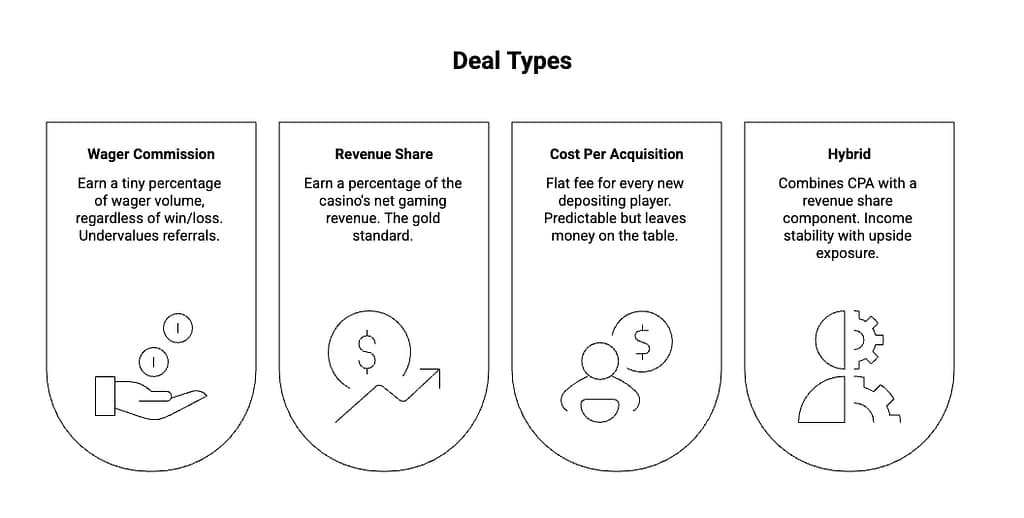
Wager Commission
Wager Commission is the worst deal you can take. You earn a tiny percentage of however much your referrals wager – regardless of whether they win or lose. The problem is obvious: if someone deposits $100,000 and runs it up to $400,000 on live blackjack, you might see $5,000 in commission. Meanwhile, under a different structure, that same player’s losses could have earned you $100,000+. Wager commission sounds safe but it dramatically undervalues your referrals.
Revenue Share
Revenue Share (RS) is the gold standard. Instead of commission on wager volume, you earn a percentage – typically 20–40% – of the casino’s net gaming revenue (NGR) from your players. NGR is GGR (total bets minus total winnings) minus bonuses, promotions, and other costs the casino absorbs – the actual profit the house makes on your players. If your player generates $60,000 in GGR and the casino’s costs bring NGR to, say, $50,000, a 30% RS deal earns you $15,000 rather than $18,000.
Cost Per Acquisition
Cost Per Acquisition (CPA) pays a flat fee for every new depositing player you refer. The upside is that it’s predictable – you know exactly what each signup is worth and you get paid regardless of whether that player wins or loses. The downside is that you leave money on the table if your referrals turn out to be high-value long-term players. For creators with access to serious depositors, RS will almost always outperform it.
Hybrid
Hybrid deals combine CPA with a revenue share component. These are more common among mid-tier creators who need income stability but still want upside exposure. The CPA covers base costs; the RS kicks in if your players perform well.
Getting a Deal in the First Place
RS codes are available to almost anyone who can demonstrate they have an audience or access to players – you don’t need 100,000 followers. The basic ask is proof of volume: previous stats, an existing player base, or even a single high-roller relationship. The lowest baseline most sites will offer is around 20% RS, and that’s essentially the floor anyone can get by asking the right people.
The more nuanced point is that deal negotiation is partly about timing and positioning. Running a free leaderboard before you have a formal deal – using an RS code – is one way to build a track record you can take into negotiations. Once a casino sees their dashboard lighting up under your code, the conversation shifts in your favor.
If you’re starting from zero and don’t yet have the stats to approach a site, the groundwork you lay before that conversation matters more than most people realize. Our guide on getting a casino sponsorship deal without an audience covers how to build credibility, how to approach smaller sites first, and what affiliate managers are actually looking at when they evaluate a new creator.
What Casinos Are Actually Evaluating
When a casino looks at whether to extend or upgrade a creator deal, they’re weighing:
- Deposit volume – are real people putting real money on site?
- NGR – after wins are paid out, what does the casino actually keep?
- Consistency – is the creator producing month over month, or was it a one-time spike?
- Player quality – are the referrals casual low-stakes users or genuine gamblers?
Wager volume matters less than many creators assume, because high wager numbers with low NGR just means your players are running up the same money repeatedly, not depositing fresh funds.
How to Retain Players
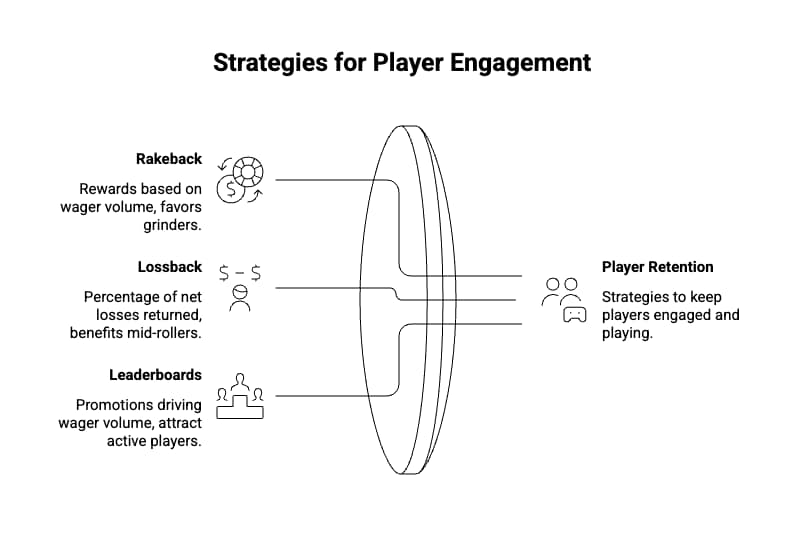
Once a creator has a deal with a casino, they typically pass some of their earnings back to their audience as incentives to play under their code. This is separate from the deal structure itself.
Rakeback
Rakeback rewards players based on how much they wager. Most creators package this as “milestones” – hit a certain wager threshold, receive a reward. It sounds attractive but the math is unfavorable to the player: if someone wagers $100,000 and loses $10,000, their milestone reward might cover $500 of that. It retains grinders but does little for people who had a bad session.
Lossback
Lossback is the more player-friendly option and the one more likely to retain mid-rollers. A player who has a losing session gets a percentage of their net losses back – typically 5-20% depending on what the creator can afford to offer from their earnings. The key insight is that mid-rollers care enormously about lossback because it softens the blow of a bad run. High rollers, by contrast, generally don’t care about rewards at all – they play wherever they feel like it and move on.
Creators funding generous lossback offers need to be careful: anyone offering 20% lossback will attract players who know how to exploit it. And if ten players all hit the lossback cap in the same month, the creator can end up paying out close to 100% of their deal value in rewards, leaving nothing for themselves.
Leaderboards
Leaderboards are the most visible creator promotion tool, but they’re often misunderstood as free marketing. A $1,000 leaderboard should, at minimum, generate 100–200x in wager volume to be worth running – meaning $100,000-$200,000 in wagers from participants. Some of the larger creators running $25,000+ leaderboards are pulling 10 million in wager volume off the back of them.
High Rollers: The Real Money
A single high-roller relationship is worth more than dozens of regular players. One high roller lost $60,000 on a single site in two weeks – generating $19,000 in RS earnings for the code holder. The same player had lost $400,000 on another platform the same period, but that was on live table games where the house edge is tiny, netting almost nothing under a wager-commission structure.
High rollers typically play across 4-5 different sites simultaneously. They don’t respond to leaderboards or lossback offers – they play for the action. The way to attract them is through personal networks and word of mouth, not Twitter ads or Discord posts. One practical approach: put each high roller on their own individual RS code rather than pooling them, so their activity doesn’t cross-contaminate with others’ wins and losses on a single dashboard.