- How Football Studio Works
- The Maths — Where the House Edge Comes From
- Counting the Combinations
- Calculating the Home/Away House Edge
- Calculating the Draw House Edge
- How Does It Compare to Other Casino Games?
- The Three Bets Explained
- Betting Strategies — What Works and Why
- Bankroll Management
- Common Mistakes — and Why They Cost You
- Game Variants
- Expert Tips
- Summary — The Short Version
Football Studio is one of Evolution Gaming’s most popular live-dealer titles — a fast, social card game where a single card is dealt to Home and one to Away, and the higher card wins. What looks like a coin flip is actually a well-defined probability problem with clear right and wrong betting choices. This guide explains exactly what those choices are, the maths behind them, and how to get the most entertainment out of every session.
Quick summary — read this first
Bet Home or Away — they return 96.27% to the player (3.73% house edge). The Draw pays 11:1 but carries a 10.36% house edge — nearly three times worse. There is no skill element that changes the long-run result, but bet selection, stake sizing, and discipline make a meaningful real-money difference. This guide gives you the numbers to make informed decisions.
How Football Studio Works
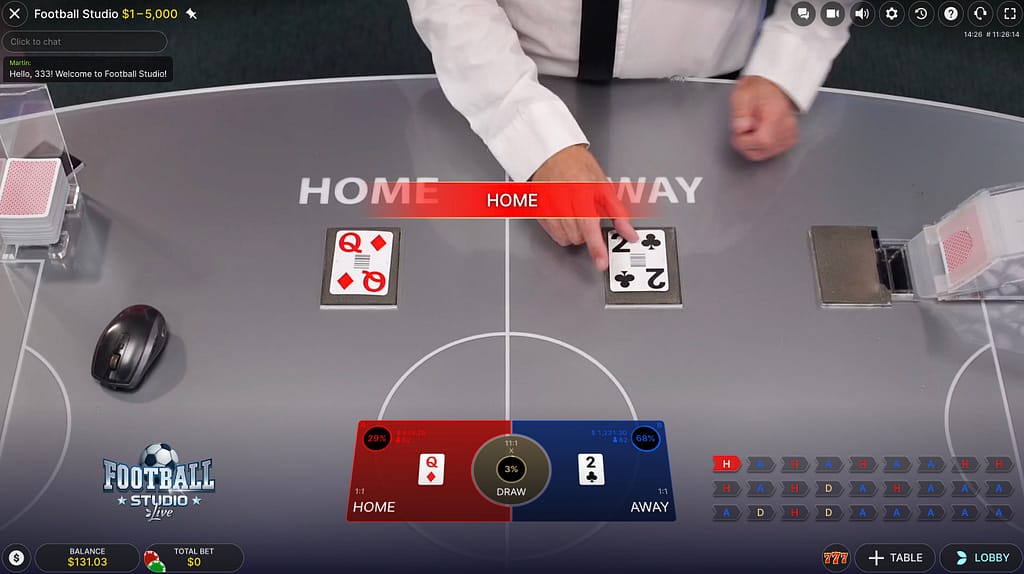
Football Studio launched in June 2018, timed to coincide with the FIFA World Cup in Russia. Evolution built the game on the same mechanical chassis as Dragon Tiger and their own Top Card — a “high card wins” format that resolves in a single deal — but wrapped it in a football broadcast aesthetic. A live host chats about real fixtures, posts predictions, and keeps the studio atmosphere buzzing between deals. The game uses eight standard decks of 52 cards (no jokers), shuffled together into a single shoe. Each round proceeds as follows:- Bet phase (~12 seconds): Place chips on Home, Away, or Draw before the timer closes.
- Deal: The dealer flips one card face-up on the Home mat and one on the Away mat.
- Settlement: The higher-ranked card wins. If both cards share the same rank, the round is a Draw.
- Tie rule: If Home or Away bettors tie, half their stake is returned — they don’t lose everything. Draw bettors win at 11:1.
The Maths — Where the House Edge Comes From
Understanding where the house edge comes from is the most valuable thing you can learn about this game. Once you see the numbers clearly, the correct betting decisions become obvious.Counting the Combinations
With eight decks, there are 416 cards total (8 × 52). When two cards are drawn from the shoe, the total number of possible two-card combinations is:Total combinations = 416 × 415 ÷ 2 = 86,320
Ties (same rank): 4 suits × 8 copies = 32 cards of each rank
Tie combos per rank = 32 × 31 ÷ 2 = 496 | 13 ranks × 496 = 6,448 ties
Win/loss combos = (86,320 − 6,448) ÷ 2 = 39,936 per side
| Outcome | Combinations | Probability | 1-in-N |
|---|---|---|---|
| Home wins | 39,936 | 46.27% | ~1 in 2.16 |
| Away wins | 39,936 | 46.27% | ~1 in 2.16 |
| Draw (tie) | 6,448 | 7.47% | ~1 in 13.4 |
Calculating the Home/Away House Edge
The expected return per £1 staked on Home (or Away) is calculated by multiplying each outcome’s probability by its payout and adding them together:Win: +£1.00 × 46.27% = +£0.4627
Tie: −£0.50 × 7.47% = −£0.0374 (half stake lost)
Loss: −£1.00 × 46.27% = −£0.4627
Expected return = +0.4627 − 0.0374 − 0.4627 = −£0.0373
House edge = 3.73% | RTP = 96.27%
Calculating the Draw House Edge
The Draw bet wins only when the cards tie (7.47% of rounds) and pays 11:1. Let’s work out the expected return:Win (tie occurs): +£11.00 × 7.47% = +£0.8213
Loss (no tie): −£1.00 × 92.53% = −£0.9253
Expected return = +0.8213 − 0.9253 = −£0.1040
House edge = 10.40% | RTP = 89.60%
⚠️ What payout would make the Draw a fair bet?
At 12:1 payout, the Draw’s house edge drops to 2.89% — actually better than the main bets. At 13:1 it would favour the player. But Evolution pays 11:1, giving them a near 10.4% edge.
How Does It Compare to Other Casino Games?
For context, here’s where Football Studio’s main bet sits among common live-casino games by house edge:| Game / Bet | House Edge | RTP | Verdict |
|---|---|---|---|
| Blackjack (basic strategy) | ~0.5% | ~99.5% | Best |
| Baccarat — Banker bet | 1.06% | 98.94% | Excellent |
| Football Studio Dice (main bet) | 2.25% | 97.75% | Very good |
| European Roulette | 2.70% | 97.30% | Good |
| Football Studio — Home/Away ✅ | 3.73% | 96.27% | Decent |
| American Roulette | 5.26% | 94.74% | Below average |
| Football Studio — Draw ❌ | 10.36% | 89.64% | Poor |
The Three Bets Explained
You’re betting the Home card will be higher than the Away card. If you win, you double your stake. If the cards tie, you receive half your stake back. If the Away card is higher, you lose your full stake. Statistically, Home wins 46.27% of rounds, loses 46.27%, and ties 7.47%. Because Home and Away are perfectly symmetrical, the choice between them is entirely cosmetic — pick whichever you prefer, or alternate for fun. The odds are identical.
You’re betting the Away card will be higher than the Home card. Outcomes, probabilities, and payouts are exactly the same as the Home bet — the game is perfectly symmetric. Some players develop a preference for one side based on football loyalty, streaks, or superstition, but no strategy can give one side an edge over the other. If in doubt, just pick one and stick with it for the session.
You’re betting that both cards will share the same rank. This happens roughly once every 13.4 rounds — about 7.47% of the time. When it does, you win 11× your stake. The catch is that the true fair-odds payout for a 7.47% event is closer to 12.4:1. Evolution offering 11:1 is why the house edge balloons to 10.36% — you’re being paid significantly less than the real odds justify.
The Draw is best thought of as a low-frequency long shot, not a core betting strategy. If the atmosphere of a potential 11× payout appeals to you, ring-fence a small fixed amount (say 5% of your session budget) for Draw bets, and never top it up. What you should never do is rely on the Draw as your primary bet — the 10.36% house edge will drain a bankroll far faster than the main bets.
Betting Strategies — What Works and Why
It’s important to be honest upfront: no betting system can change the long-run expected return of a game with a negative expected value. The house edge is a mathematical constant — every £100 you bet on Home/Away loses an average of £3.73 over time, regardless of how you arrange your bets. What strategies can do is shape how that variance is distributed: more frequent small losses, fewer catastrophic ones, or the reverse. Here’s a ranked breakdown.Flat betting — the baseline ✅
Wager the same fixed amount every single round. If your session budget is £50 and you bet £1 per round, you can sustain 50 consecutive losses before busting — which is nearly impossible in practice. Flat betting is the best option for players who want to maximise playing time, experience minimal stress, and avoid catastrophic loss spikes. It also makes it easy to track exactly how the session is going. There’s no illusion of a “system” here — it’s purely disciplined play.
Paroli (reverse Martingale) — the upside-down approach ✅
Start with a base stake. After each win, double your bet for the next round. After three consecutive wins (or any win target you set in advance), return to your base stake regardless of the outcome. The key difference from the Martingale is that you’re pressing profit, not chasing losses. A losing streak during Paroli only costs you your base stake per round — the damage is limited. The risk comes when a winning streak ends mid-progression: you give back some accumulated profit. Example with a £5 base:
Martingale — popular but dangerous ⚠️
Double your bet after every loss, return to base after every win. The appeal is that a single win always recovers all previous losses plus the original base profit. The problem is the exponential bet size growth during losing streaks, combined with the reality of table maximums. Starting with a £5 bet:
A 7-loss streak from a £5 base requires a £640 bet to recover — which most tables won’t allow. And a 7-loss run isn’t rare: with a ~46% loss rate per round, the probability of losing 7 in a row is approximately 0.54⁷ ≈ 1.5%. Over 100 rounds of play, you should expect at least one such run. Use Martingale only with a very small base stake (e.g. 0.5% of budget), hard-capped at 4–5 doublings, and only if you fully understand you may lose the full progression.
D’Alembert — the gentle middle ground ✅
Increase your bet by one unit after a loss, decrease by one unit after a win. It’s a much slower progression than the Martingale — a 7-loss streak from a £5 base only takes you to £40, compared to £640 with the Martingale. The catch is that you need more wins than losses to return to profit, and because Football Studio’s win/loss probabilities are nearly equal, this isn’t guaranteed. D’Alembert suits players who want a gentle progression feel with capped exposure.
Bankroll Management
Because Football Studio deals ~100 rounds per hour and the house edge operates on every single bet, bankroll management is genuinely the most practical tool you have. A session with a well-managed bankroll can last hours even when variance runs against you; poor staking can turn a winning session into a busted one.💰 Stake size
Keep each bet between 1–2% of your session bankroll. At 1% and a 46% win rate, variance alone won’t wipe you out in a normal session. If you want to use Martingale, drop to 0.5% base to give yourself room for doublings.
🛑 Loss limit
Set a hard stop-loss before you begin — e.g. 30–50% of session budget. When you hit it, you leave. Use the operator’s own responsible-gambling tools to enforce it automatically; don’t rely on willpower in the moment.
🎯 Win goal
Set a target profit before you start — e.g. up 25–30%. Once you hit it, lock in those winnings and stop. Variance can return profits quickly at 100+ rounds/hour; a win goal protects you from riding a winning session back to zero.
⏱ Session time
Set a hard session time limit. At 100 rounds/hour you make a lot of individual betting decisions under time pressure — fatigue degrades discipline. 45–60 minutes is a sensible single-session ceiling for most players.
📊 Practical example — £100 session budget
Base stake: £1 (1% of £100) | Loss limit: £30 | Win goal: £25 | Time: 45 minutes
Over 100 rounds flat betting, expected loss = £1 × 3.73% × 100 = £3.73
In practice you’ll be up or down more due to variance — but the 1% stake means you have a large cushion. A 15-round losing streak (which happens occasionally) costs only £15 — half your loss limit, leaving room to recover. Compare this to flat betting £5/round: the same streak wipes £75, exceeding your loss limit on a normal fluctuation.
Common Mistakes — and Why They Cost You
❌ Believing the result history predicts the next card
The scoreboard showing the last 20 results, the “Home on a 6-round streak” display, the “Away hasn’t won in 8 rounds” counter — all of this is entertainment, not information. Each deal is drawn from a freshly shuffled eight-deck shoe with no memory of previous rounds. If Away hasn’t won in 8 rounds, it is no more or less likely to win the next round. This is the gambler’s fallacy, and the table’s streak display is specifically designed to make it feel like patterns exist. They don’t.
❌ Making the Draw your primary bet
The 11:1 payout is tempting, but a 10.36% house edge means that for every £100 you stake on the Draw, you lose £10.36 on average — versus £3.73 on the main bets. Over a 100-round session betting £1 on Draw every round, expected loss is £10.36 versus £3.73 on Home. That’s a difference of £6.63 per session for the same activity. If you enjoy the Draw, budget for it separately as a novelty, but the numbers don’t support using it as a core strategy.
⚠️ Using Martingale without a hard cap
Players often start Martingale with a “I’ll stop after 5 doublings” mental rule, then abandon it when they’re actually in a losing streak because “it must turn around soon.” This is exactly how you hit table maximums or blow your entire bankroll. The rule has to be set in stone before the session starts and treated as non-negotiable mid-session. Better still, write it down: “My Martingale cap is 5 doublings. If I lose all 5, I accept that loss and move on.”
⚠️ Chasing losses by increasing stake size
Doubling your stake mid-session to “catch up” after a run of losses is not a strategy — it’s an emotional response that increases your expected losses. If you’re down £30 and switch from £1 to £5 bets to recover quickly, you’ve increased your expected loss rate fivefold. The house edge on your new £5 bets is still 3.73% — it hasn’t changed because you’re on a losing run. The only rational response to a bad run is to stick to your plan or stop for the session.
Game Variants
Evolution has expanded the Football Studio brand into several variants. The rules and RTP differ meaningfully between them — here’s what you need to know.Football Studio
96.27% RTPThe original. Eight-deck card game, live host, football broadcast atmosphere. Best for fans who want an immersive social session. The foundational option.
Football Studio Dice
97.75% RTP ⭐Best RTP in the range
Two dice each side; highest total wins. Main bet RTP is 97.75% — the best in the Football Studio family. The 12-12 draw pays 80:1 for a high-variance long-shot option. Recommended if you care more about value than the card mechanic.
First Person Football Studio
96.27% RTPSingle-player RNG version with a “Go Live” jump button. Same rules and RTP as the main game. Ideal for learning the flow before joining the live table — no time pressure, no host chat.
Football Studio US
96.27% RTPSame card game reskinned for NFL and college football audiences. Identical rules, probabilities, and payouts. Choose based purely on which theme you prefer.
Expert Tips
💡 Start with First Person mode
Before risking money at the live table, spend 10 minutes in First Person Football Studio. The betting timer in the live game moves fast — about 12 seconds — and it’s easy to mis-click or over-stake under pressure. Getting comfortable with the interface first costs nothing.
💡 Check the Draw payout before playing
Standard is 11:1 (10.36% edge). Some operators configure it at 10:1 (17.83% edge) or even 8:1 (32.77% edge). Always check the table’s posted paytable before placing a Draw bet — the difference is enormous. If the Draw pays below 11:1, don’t touch it.
💡 Football Studio is not sports betting
It looks and feels like a live sports show, and the host’s football knowledge and match predictions are entertaining. But the Home and Away outcomes have nothing to do with real football results — they’re determined by random cards from a shuffled shoe. The football theme is atmosphere, not information.
💡 Consider Football Studio Dice for better value
If long-run value matters more than the card mechanic, Football Studio Dice offers 97.75% RTP on main bets — 1.48 percentage points better than the card game. Over 1,000 rounds of £1 betting, that difference is ~£15 in expected losses. Small per session, but real over time.
Summary — The Short Version
Everything you need to remember:
- Bet Home or Away — 96.27% RTP, 3.73% house edge. Both identical, pick one.
- Avoid the Draw as a core bet — 89.64% RTP, 10.36% house edge. Budget it separately as a novelty only.
- Stake 1–2% of session budget per round. Small stakes = more rounds, more time, more control.
- Set loss limit, win goal, and time limit before you start. Use operator tools to enforce them.
- Ignore the result history — each round is independent, the scoreboard tells you nothing.
- No system beats the house edge — strategies shape variance, they can’t change expected value.
- Try Football Studio Dice for a 97.75% RTP main bet if value is your priority.
Football Studio is a game of chance. All outcomes are independent. RTP figures are long-run theoretical averages — individual sessions can vary significantly. Please gamble responsibly and only with money you can afford to lose. If gambling stops being fun, use your operator’s responsible gambling tools or visit BeGambleAware.org.